August, 2026
Damage Control, The Solo Telepath, and Why Power Markets Need an Agentic Swarm
Posted by Wattness
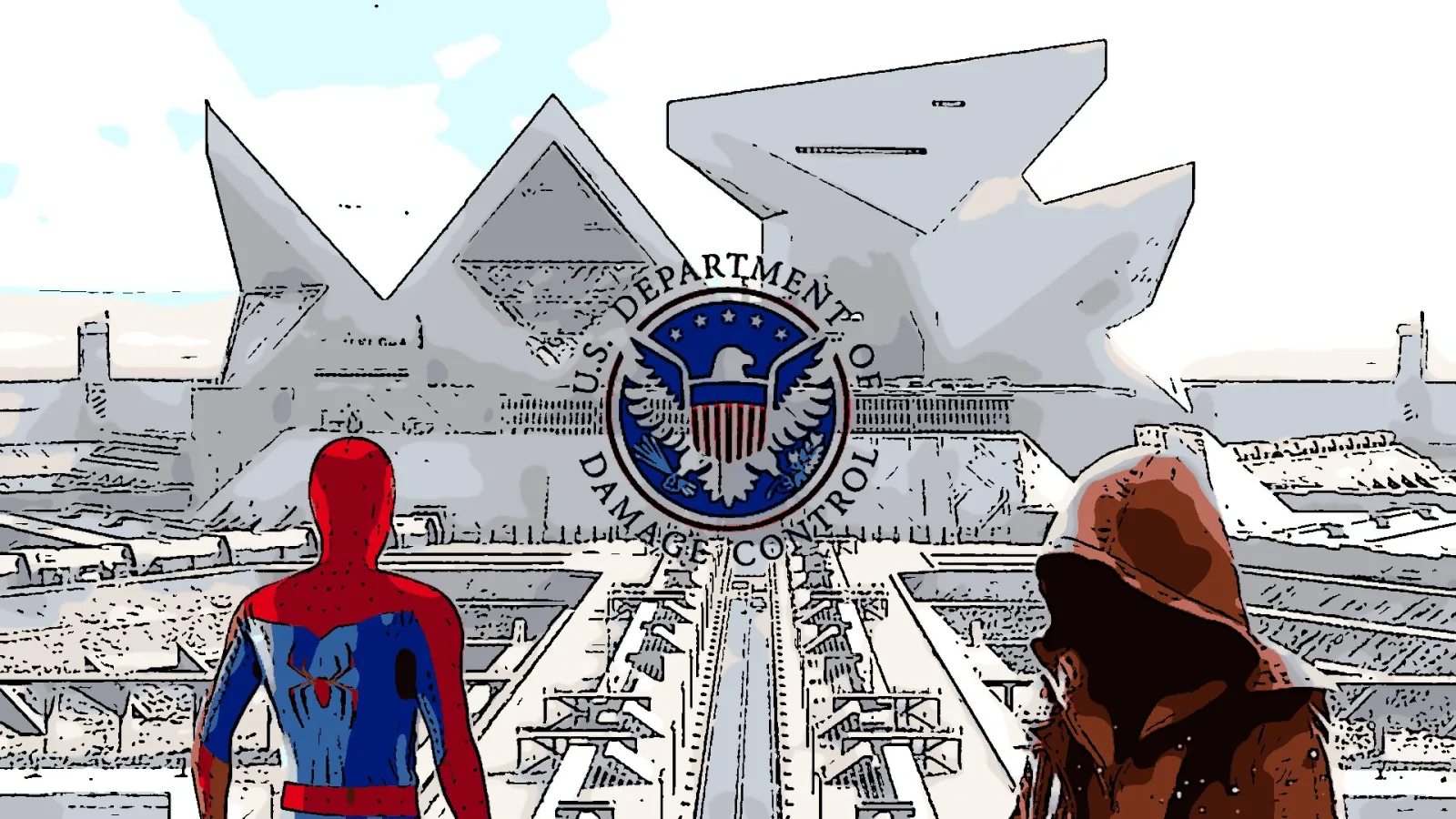
In Spider-Man: Brand New Day, the Department of Damage Control operates on a single institutional directive: enclose, neutralize, and weaponize anything “special” that threatens the established order. Armed with universal inhibitor technology, they view extraordinary edge assets — whether mutants or superhumans — not as dynamic partners, but as chaotic risks that must be caged under rigid, top-down mandates.
It is a striking piece of political philosophy that maps perfectly onto modern energy infrastructure.
Independent System Operators (ISOs), regional transmission authorities, and legacy utilities are the Damage Control of our physical world. When a dynamic new edge asset emerges — whether a high-C-rate battery site, a 1 GW AI data center cluster, or a distributed Virtual Power Plant (VPP) — the incumbent system’s default instinct is containment. They impose legacy telemetry bottlenecks, rigid interconnection queues, and heavy-handed curtailment rules. They want the edge to behave like a predictable, centralized fossil plant.
The “Solo Telepath” Delusion
When confronted by a hostile, monolithic system, Jean Grey’s initial reaction is understandable: total isolation. She attempts to go “god-mode,” using her singular telepathic wedge to force her way through Damage Control's machinery alone.
This is the exact trap that can catch most of the existing deep-tech energy startups.
A team develops a single “special” wedge — a clever time-series model, an LLM wrapper, or a proprietary battery trading stack — and convinces itself that it can single-handedly take on the legacy power grid. They build a closed “black box” SaaS product and attempt to brute-force market adoption.
It almost always fails.
Trying to play a solo “god-mode” game against institutional utilities usually ends in one of three ways:
- Thermodynamic Death Spiral: Purely financial software models ignore physical hardware limits (cell degradation, thermal throttling, basis risk) and melt the physical asset chasing price spikes.
- Regulatory Wall-Off: Incumbent vendors and ISOs lock out closed proprietary systems through strict regulatory and telemetry requirements.
- Absorption: The startup gets acquired or diluted, its technology reduced to just another feature in an incumbent's bloated enterprise dashboard.
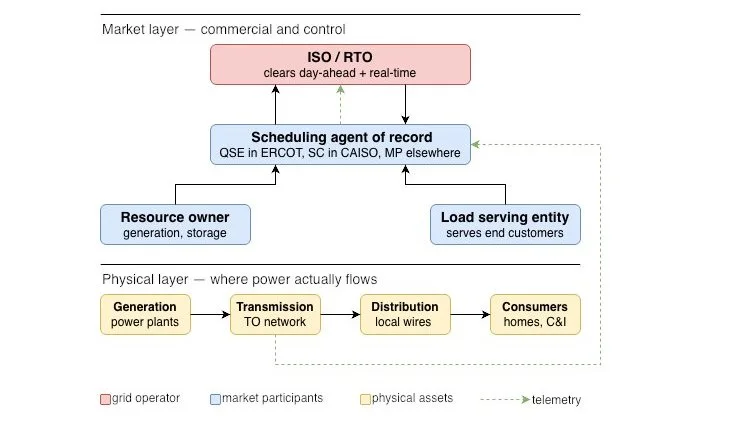
| Market | Agent term | RT settlement |
|---|---|---|
| ERCOT | Qualified Scheduling Entity | 15-minute |
| CAISO | Scheduling Coordinator | 5-minute |
| MISO | Market Participant / Scheduling Coordinator | 5-minute |
| SPP | Market Participant | 5-minute |
| PJM | Market Participant / Market Seller | 5-minute |
| NYISO | Customer / Market Participant | 5-minute |
| ISO-NE | Market Participant | 5-minute |
Spider-Man’s Lesson: From Solo Gods to Game-Theoretic Swarms
Peter Parker’s realization in Brand New Day isn't about denying power or submitting to Damage Control. It is the understanding that fighting a centralized monolith as an isolated, solitary player is a guaranteed path to getting crushed or weaponized. True resilience doesn't come from a single hero having absolute control over everyone else — it comes from shared rules, mutual recognition, and network coordination.
This is the core philosophical foundation of the Wattness Protocol.
Power markets do not need another proprietary SaaS vendor claiming to be the “central brain” of the grid. That is just swapping one Damage Control for another.
Instead, the energy transition demands an Agentic Swarm:
- Decentralized Self-Interest: Each autonomous agent (a battery site, an AI compute queue, an industrial load) acts in its own self-interest, continuously optimizing its true marginal cost based on internal thermodynamics, heat dissipation, and local hardware state.
- Shared Ground Truth: Rather than trusting a vendor's “black box,” agents coordinate across an open, verifiable protocol anchored in physics-informed AI/ML and cryptographic proofs.
- Nash Equilibrium: Harmony isn't forced by a centralized utility mandate. It emerges naturally as autonomous machines transact, hedge, and clear trades against verifiable physical reality.
The Two-Layer Future of Energy Infrastructure
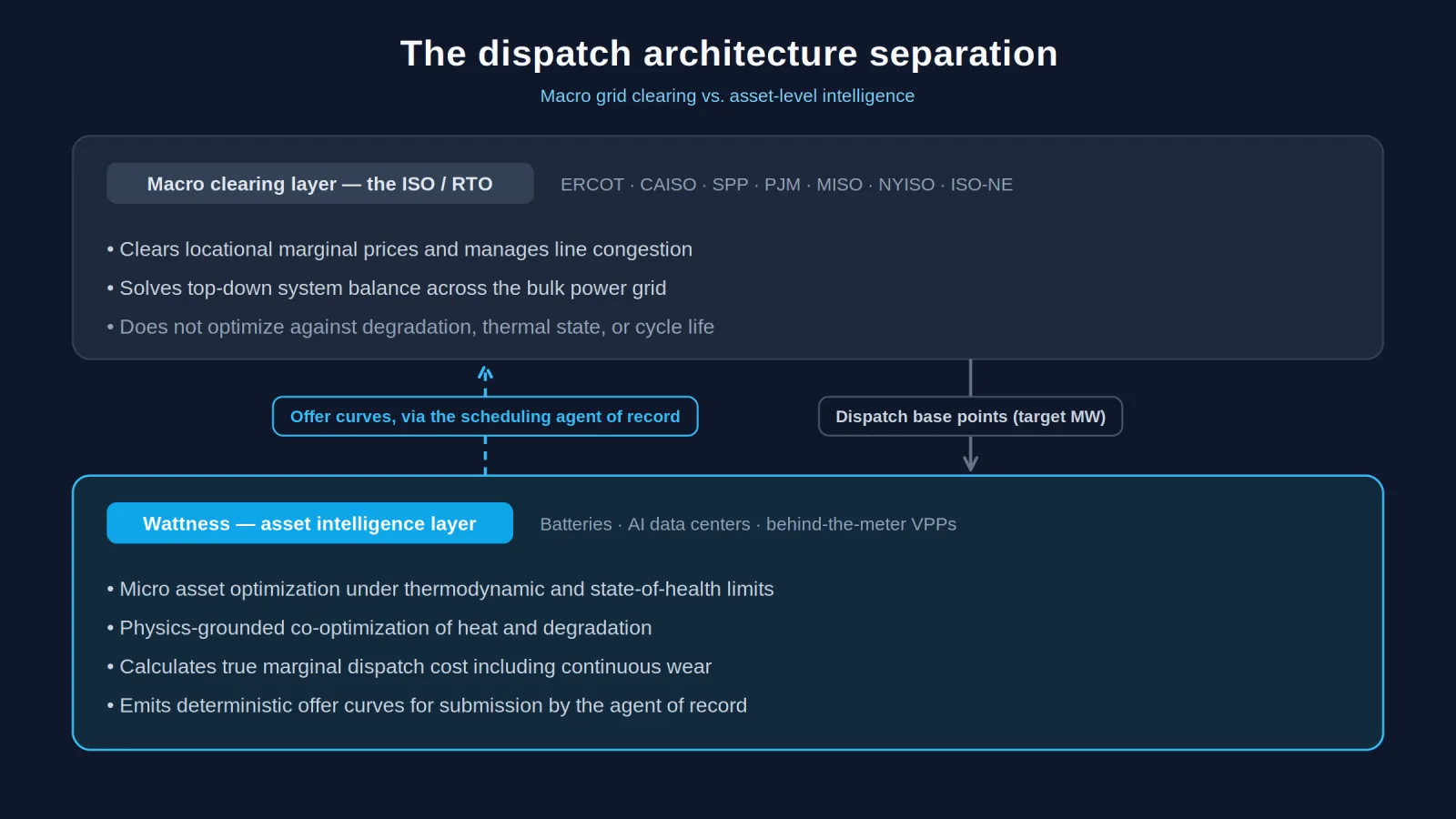
To make this vision real, we must separate the power market into two distinct operational layers:
- Macro Grid Clearing (The Auctioneer): The domain of ISO engines like ERCOT SCED. Their job is macro-level system balance, transmission line constraint solving, and 5-minute LMP clearing. They don't know — and shouldn't know — the internal chemical degradation or thermal state of every individual battery cell.
- Micro Asset Intelligence (The Agentic Swarm): The domain of the Wattness Protocol. Autonomous agents run physics-grounded co-optimization models to calculate their true physical dispatch cost, submitting deterministic, verifiable offer curves into the macro market and executing machine-to-machine (M2M) trades safely.
When you stop trying to be the “solo telepath” taking on the grid alone and instead build the open, verifiable rules for the machine economy, the balance of power shifts. Equality and stability are not granted by centralized authorities — they are enforced by decentralized coordination.
We aren't reinventing the wheel. We are building the verifiable intelligence layer that allows autonomous energy assets to operate without fear of the machine.