
August, 2026
Every Place That Ever Was
Posted by Wattness
What a horror film about a man lost in his own maze has to say about deciding — and measuring — at the edge of the grid.
A note before we begin: this discusses the ending of Backrooms.
Before the doorway opens, the man is already lost.
Clark owns a furniture store that no longer sells furniture. He sleeps in the showroom, on a display bed, in the middle of a warehouse arranged to look like rooms nobody lives in. He wanted to be an architect and never became one, and every failure since has been filed under someone else's name. He has a therapist he argues with and a marriage he has narrated into a story where he is the injured party. He is a man who trusts his own account of himself more than any evidence to the contrary. This is the important thing about him, and the film establishes it long before anything supernatural happens. The maze does not make Clark what he is. It only gives him room to be it at scale.
Then a seam of light appears in a wall in the basement, where no door should be, and he falls through it into the Backrooms: a space of yellow corridors and humming lights that goes on without end, furnished with objects it seems to half-remember. A chair that is two chairs fused into one. Furniture the space grew rather than furniture anyone built.
What Clark does next is the whole film. He does not treat the new place as a danger to be surveyed. He treats it as opportunity, as territory, as a structure at last worth drawing. He goes back, again and again. He maps it. The failed architect finally has a floor plan. And he trusts the map.
This is where the film starts describing something I think about constantly, which is what happens at the edge of an electricity grid when an operator trusts a map of its own making.
Some plain background, because the rest depends on it. Wholesale power markets are places where owners of physical machines — generators, batteries, large flexible loads like data centres — offer to buy or sell electricity minute by minute. In Texas, the market operator re-runs a dispatch calculation every few minutes and settles the money on a slightly slower clock. To participate, you submit an offer: a curve that says how much you will deliver, and at what price. The offer is a claim about yourself. Nobody at the control room can see inside your machine. They can only see what you told them and what actually arrived.
That gap — between the claim and the arrival — is the subject of the film, whether or not it knows it.
Clark's maps keep going obsolete. He draws a room, returns, and the room has moved. At one point he finds, scrawled on a wall, an admission that the floor plan has changed again and that the handwriting on the revised plan looks like his own. The geometry will not hold still, so a map drawn from memory cannot survive contact with the place. This is not a flaw in Clark's draughtsmanship. It is a category error. He is mapping a thing that is not fixed as though it were, and he is doing it from the inside, from recollection, rather than reading the space as it currently is.
The equivalent error in a power market is the most common one there is. Two grid-scale batteries can have identical connection capacity on paper and be entirely different machines in the moment. One sits full, cool, early in its life. The other sits low, has been cycled hard through an afternoon of price swings, and is close to the temperature at which it must throttle itself to avoid damage. They cannot deliver the same energy. They cannot hold it for the same duration. And the real cost of a discharge — the future life it consumes — differs between them by a wide margin. A data centre is no steadier: a training job at the start of its work can pause; the same job deep into a long computation cannot be interrupted without loss. The interruptible fraction is not a constant. It is a state, and it changes by the minute.
So the nameplate — the number on the plate bolted to the machine — is a map drawn from memory. It describes the asset as it was imagined, not as it is. An operator who offers against nameplate and price alone, and ignores charge, wear and heat, is Clark with his floor plan: confident, industrious, and describing a room that has already moved.
The film has a second image for the same failure, and it is worse.
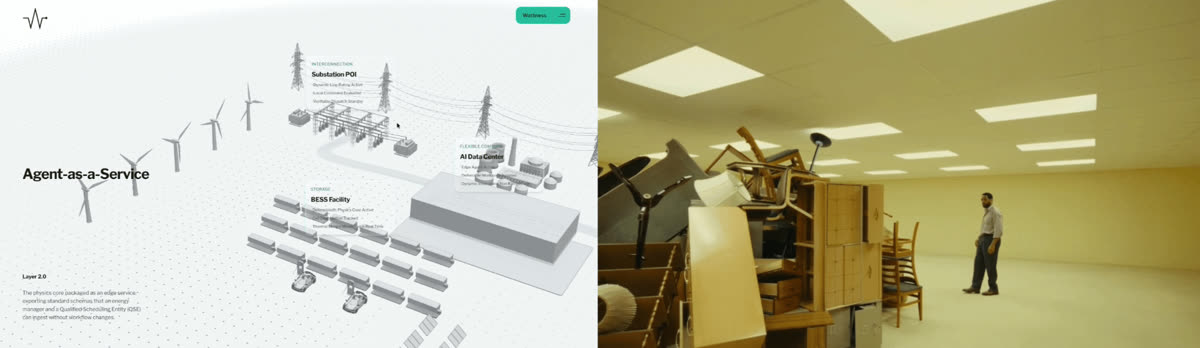
Deeper in, Clark stops mapping and starts living. He takes up residence among the "Still Lifes" — imitations of people the space has assembled out of fading memory. They sit at his table. They do not move, do not feel, do not object. He can stab one and it does not flinch. He has even discovered he can eat them. There is a copy of his wife among them, red-haired and wrong, kept for the role she plays rather than the person she was. The Still Lifes look, at a distance, exactly like the real thing. Up close, examined, touched, they are hollow. They are what the place produces when it remembers something too many times: each copy a little more degraded than the last, all of them passing for real until something asks them to perform.
I have never seen a cleaner picture of an over-declared capability.
In a constrained interval — the rare window when the grid is short and every megawatt matters — the allocation of scarce room goes, under some proposed designs, in proportion to what each member says it can do. Say you can shed a great deal of load, and you are handed a large share of the scarce headroom. The trouble is that saying so costs nothing. A member who declares far more flexible demand than it ever intends to give takes a larger slice of every tight interval, directly at the expense of the members who declared honestly. The declaration is a Still Life. It sits at the table looking exactly like capability. It has never once been asked to perform under curtailment, and on the day it is asked, it does not move.
This matters most in the very intervals nobody can afford it to matter. Electricity outcomes are not spread evenly through the year. A small number of scarcity hours dominate everything; the thousands of ordinary hours are, for this purpose, noise. A capability that averages well across a mild year but fails in the one afternoon that counts has told you nothing you needed to know. The copies are convincing precisely until the constraint binds — and the constraint is the only moment that was ever the point.
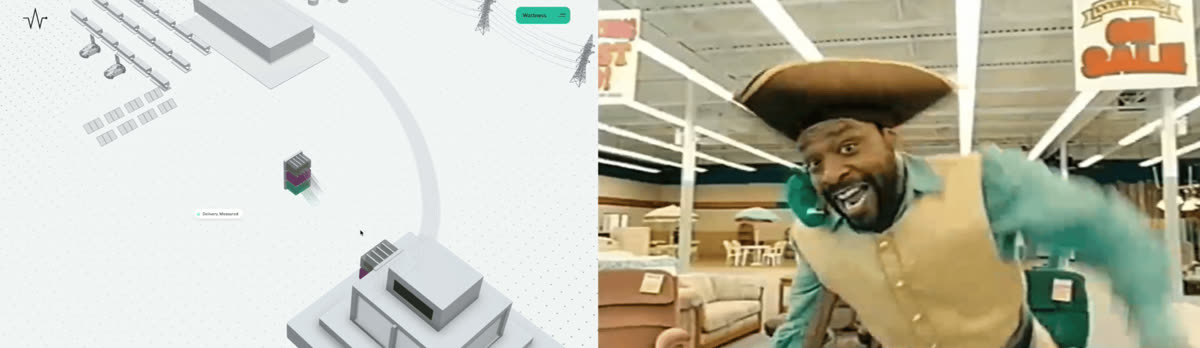
Which brings us to the monster, because the film is careful about what the monster is.
The creature that hunts the corridors, that killed the researcher in the opening footage, that finally kills Clark, is not a demon and not an intruder. It is Clark. It is a towering, deformed version of him, dressed in the mascot costume he wore in his own store's commercials — the face of the business he was failing to run. The thing that destroys him is a distorted copy of himself that he never looked at directly. He optimised his account of who he was. He never audited it. And the unaudited version came for him wearing his own advertising.
This is the most exact thing the film says about operating without a physics core. The monster is not the market. It is not volatility, not the price, not bad luck. It is the physical consequence of running against your own story instead of your own state — the degradation you didn't price, the thermal limit you didn't read, the true marginal cost of a decision arriving, at last, in person. It does not come from outside. It was always the asset, run without measurement, allowed to grow in the dark.
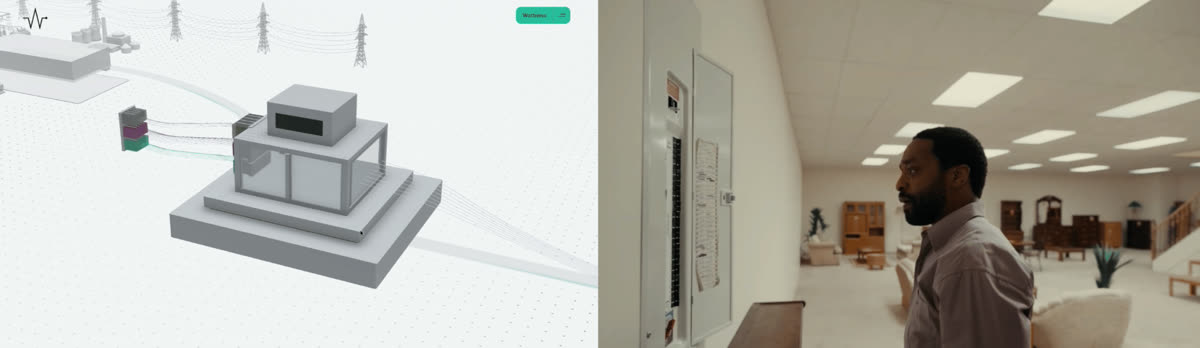
The response to all of this is not a bigger map. Clark's problem was never resolution. It was that he was drawing from memory a place that had to be read from the machine.
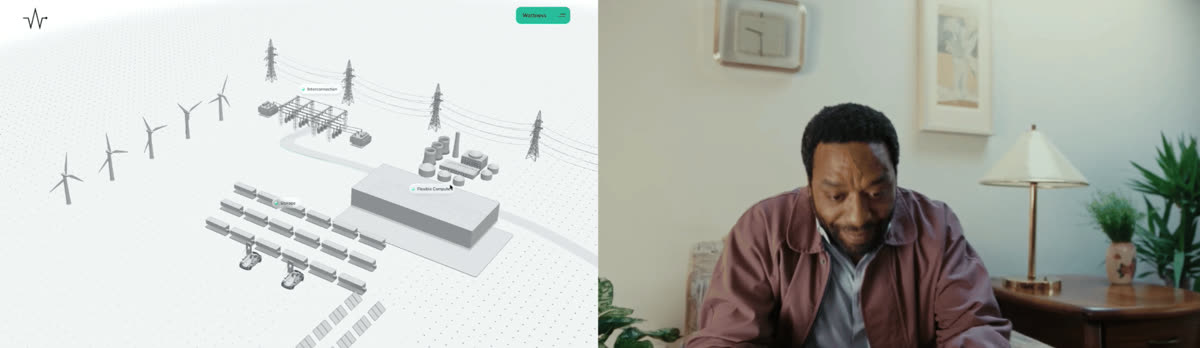
So the first thing worth building is a model that lives at the asset and reads it rather than assuming it. Charge, wear and thermal headroom enter the decision directly, not as limits bolted on after the fact, so that the cost of a discharge already contains the life it will consume. This is not a forecast and not a story. It is deterministic and inspectable: given the same machine in the same state, it returns the same decision, and anyone can open it and see why. It is worth saying that the market operator in Texas has already moved in this direction. Since its most recent redesign — the largest change to its real-time market since that market began — the dispatch engine reads each storage asset's reported state of charge and will not issue an instruction the asset's own physics cannot honour. The scarcity signal is being written into the numbers. An operator who treats members as interchangeable when the machine underneath does not is drawing a floor plan the market will spend the next interval correcting.
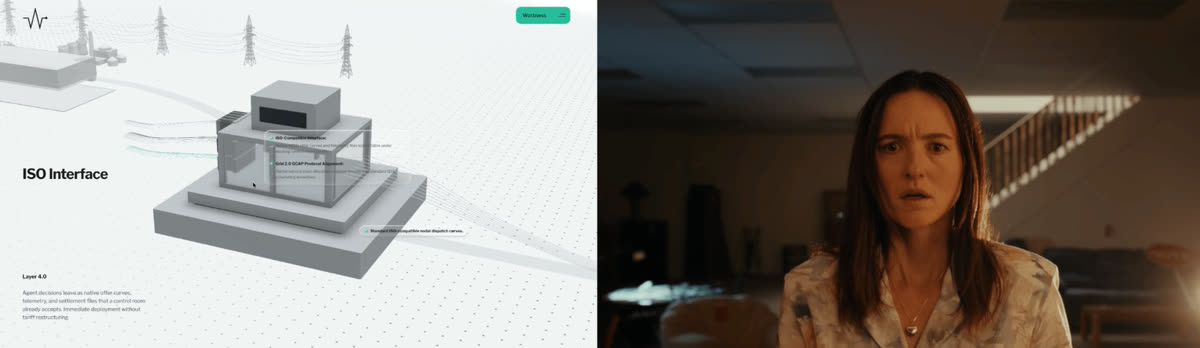
But a physics core at the edge is not enough on its own, and here the film gives us its best character.
Mary is the therapist. She enters the Backrooms after Clark, not to conquer it, not to become its cartographer, not to replace Clark as the intelligence at its centre. She goes in to find one person and get out. She is wrong about almost everything the place is, and she never pretends otherwise. What she carries is small: a piece of concrete with a child's handprint pressed into it, taken from the home she grew up in, the home now demolished. It is the one object in the film that does not degrade. Everything the space touches yellows, softens, forgets itself. The handprint is a fixed record of something that actually happened, carried in from outside, and it is the thing she reaches for — literally, physically — when the copies and the corridors and the monster have made every other map useless.
That is verification, and it is the part most people building at the edge leave out.
An edge that decides for itself and reports on itself is an edge that cannot be checked, and the failure will not show until a scarcity interval, when it is expensive. So the decision has to arrive with a proof attached: a record of what was offered and what was delivered, kept so that someone who was not present when the decision was made can reconstruct it afterward. This is not a market run on some exotic ledger, and it has nothing to do with the vocabulary that word usually drags in. It is the plainer, older idea that a claim about delivery should be measured against what actually happened, and that the measurement should be a small, portable, non-degrading thing you can carry into the room when every other account has yellowed. It is Mary's handprint: the one artifact that still means what it says.
From measurement you get the only honest fix for the over-declaration problem, and it needs no price. Weight each member's declaration by its own measured history — the ratio of what it actually delivered, when it was called, to what it said it would deliver. Inflate the claim and the multiplier falls, and the inflation cancels itself out. The allocator still runs its simple proportional rule; it simply runs it over demonstrated capability rather than stated ambition. A newcomer with no record starts neutral and earns its standing by performing. The Still Life stops being rewarded for looking like the real thing, because the only thing that counts is the record of what it did when the constraint last bound.
And there is a subtlety the film also honours. Mary's handprint does not survive the film. She uses it against the monster and it breaks. A measure that is spent in the using, that is fragile, that exists only in one hand, is not yet infrastructure. The point is not to carry one heroic artifact into one dark room. It is to make the record ordinary — attached to every decision, checkable by anyone, and never sitting between the asset and the market, only travelling alongside the offer the market already knows how to read.
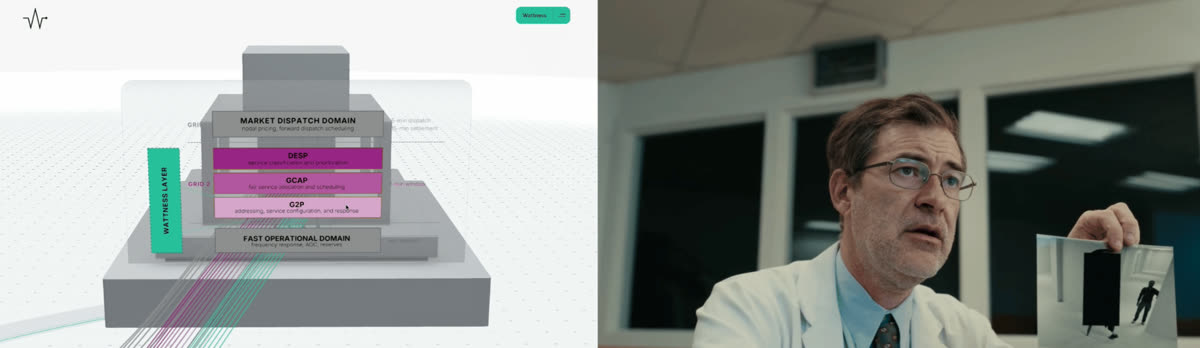
Which is where the institution comes in, and the film is fair to it.
Async — the research body that opened the threshold, watches the corridors on its cameras, sets the traps, and takes in the survivors — is not the villain. Someone has to hold the threshold. Someone has to receive the outputs and keep the records and decide what is contained. Phil, the scientist who meets Mary at the end, is not malicious; he is a man convinced he is standing at the edge of the most important thing that has ever happened, and he may well be right. The problem with Async is not that it exists. It is that watching is not the same as deciding well, and an institution that can see everything on a monitor still cannot see inside the machine. When Mary asks what will happen to her, Phil says it is not up to him. That is the honest answer of an allocating layer with no intelligence of its own: it can hold the threshold, but it cannot judge a capability it never measured.
This is the right shape for the standards body and the control room. Necessary. Not to be distrusted. But not sufficient by itself when the layer that hands out access is, by its own admission, an allocator without judgement. The judgement has to live below it, at the asset, in the physics core — and the proof has to travel up to the institution in a form it can already accept: ordinary offers, ordinary telemetry, ordinary settlement files. No new permission. No tariff rewritten. Nothing the control room has to be taught to read.
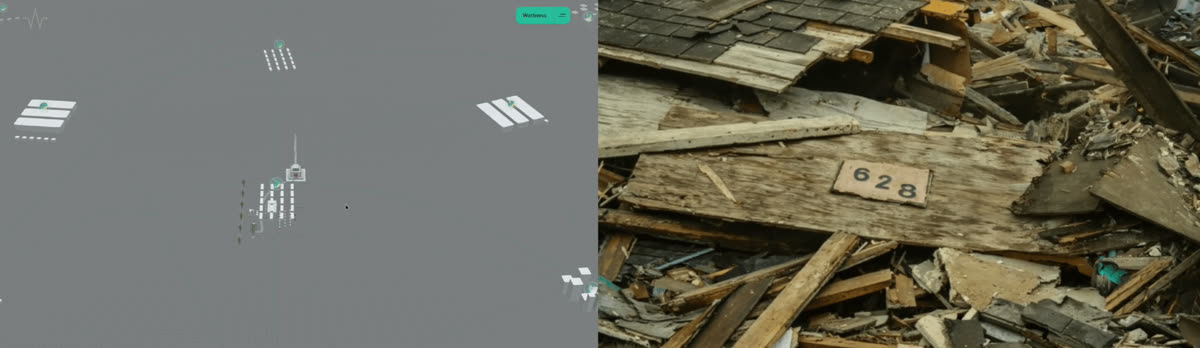
Then the film pulls back, and the last image is the argument.
At the end we learn the Backrooms is not one maze. It is a cache of every place that ever was, all of them copied, all of them degrading, all of them somewhere in the endless yellow at once. The closing montage shows the copies multiplying — the missing employees' home, Clark's store, Mary's demolished childhood house with the handprints eerily restored, and finally a copy of the very room Mary is sitting in, with a degraded copy of Mary already inside it. The maze was never local. It was correlated all along, bound together by shared memory.
Storage assets across a region are correlated in exactly this way, and it is the failure mode nobody prices. They share weather. They share ambient temperature. They share the same price signal, which tells them all to do the same thing at the same moment. So the temperature at which they each throttle themselves clusters, and assets that look independent on a map are in fact one asset wearing many faces — all of them likely to fail to deliver in the same interval, for the same physical reason, the reason no declaration mentioned. An allocator that sees only declared size cannot see this forming. An allocator fed real capability — sustainable duration, permitted ramp, one honest number about headroom computed locally from whatever physics governs each machine — can see the cluster in the declarations before it becomes a simultaneous failure in the delivery.
The answer the last shot argues for is not a single controller sitting above the whole region, reading one master map. That is Clark's dream, scaled up: one intelligence at the centre of the maze, and we have watched how that ends. The answer is a mesh — every site running its own physics, keeping its own proofs, coordinating with its neighbours rather than reporting to a tower. Not the absence of operators; operators do not disappear, and they will never share a single objective, because each has its own commercial position and its own view of which hours matter. What is achievable, and what is worth building, is the absence of a single point of control. That is the stronger claim, and it is the one the film's final zoom-out makes for you: not one maze with one map, but many places, each read honestly from the inside, none of them mistaking the story it tells about itself for the machine it actually is.
Everything must go, the sign in Clark's window says, over and over, in the corridors that copied his failing store. It is a liquidation notice. It is also, read the other way, a fair description of what happens to any operator who trusts the map over the machine. Everything must go. The only question the film leaves open is whether anyone was measuring when it did.