
August, 2026
The Grid Is an Exchange: A Crypto Trader's Guide to US Wholesale Power Markets
Posted by Wattness
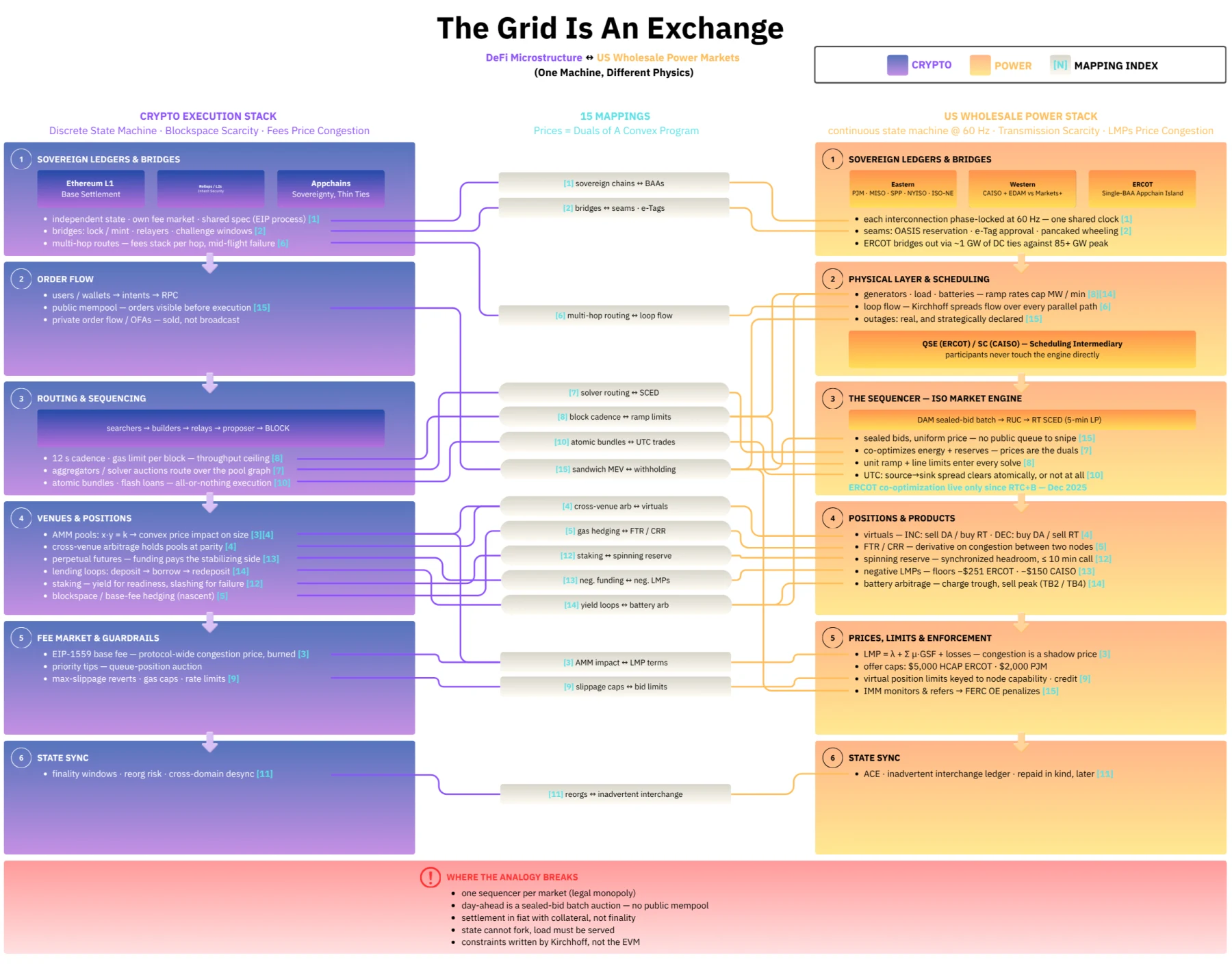
If you know how to trade crypto, search MEV, or build arbitrage bots across decentralized exchanges, you already understand 90% of wholesale energy trading.
Both systems are constrained-resource allocation engines. They route capital or electrons through complex network graphs, clear via optimization, and publish state through congestion-priced variables.
Ethereum uses EIP-1559 base fees, AMM invariants, and solver auctions to manage blockspace. The US electrical grid uses Security-Constrained Economic Dispatch (SCED) and Locational Marginal Pricing (LMP) to manage high-voltage transmission lines.
Here is the technical walkthrough bridging DeFi microstructure with US power markets.
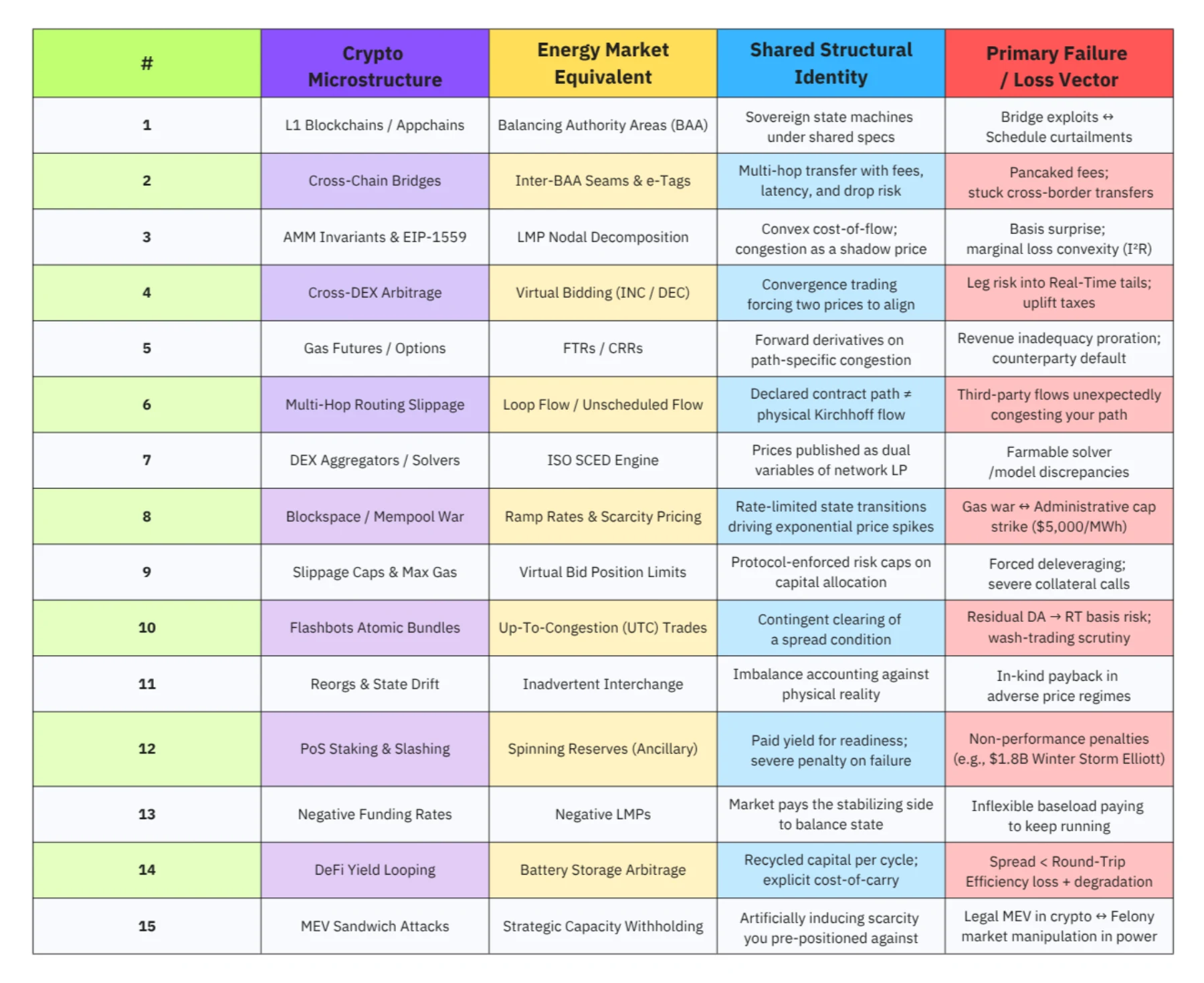
1. System Architecture: L1 Blockchains vs. Balancing Authorities
In crypto, sovereign L1s and appchains (Ethereum, Solana, Arbitrum) run independent state machines. Each maintains its own validator set, consensus rules, base fee market, and state transition ledger.
In US energy markets, the physical grid is divided into 60 Hz Synchronous Interconnections (Eastern, Western, and ERCOT). An interconnection represents the most literal consensus domain in physics: every generator rotor and industrial motor across the footprint is phase-locked to the exact same 60 Hz electrical heartbeat.
Within these physical consensus domains sit Balancing Authority Areas (BAAs) — sovereign execution environments managed by Regional Transmission Organizations (ISOs) or individual utilities.
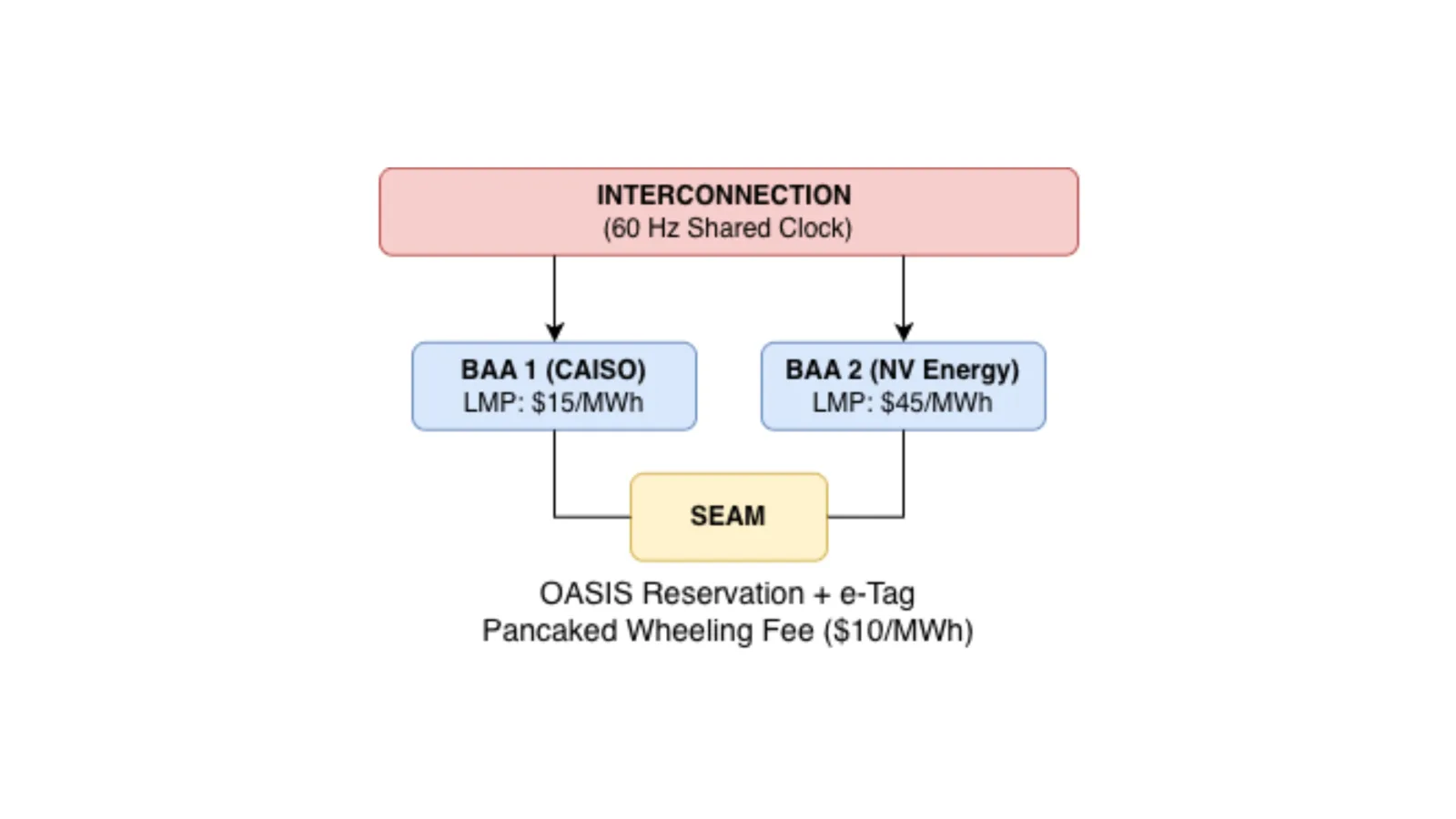
The Sovereign State Machine
Each BAA acts as a sovereign execution environment:
- Local Balancing: Continuously balances generation against load to minimize its Area Control Error (ACE).
- Independent Market Rules: Operates under its own tariff filings, dispatch software, and clearing engine (mirroring EIP protocol specifications).
- Appchain Architecture (ERCOT): Texas operates as a single-BAA electrical island — an appchain connected to the rest of the US through roughly 1 GW of asynchronous DC ties against 85+ GW of internal peak load. It trades cross-domain liquidity for absolute regulatory and operational sovereignty.
2. Interoperability & Transfer Mechanics: Cross-Chain Bridges vs. Inter-BAA Seams
Because BAAs and L1 chains operate as isolated state machines, moving value across their borders introduces the exact same engineering constraint: executing state changes across distinct administrative boundaries without shared state atomicity.
When a trader spots a spatial price spread between two domains — whether arbitraging ETH across Ethereum and Arbitrum or solar power from CAISO to Nevada — the execution must traverse a four-stage cross-domain pipeline.
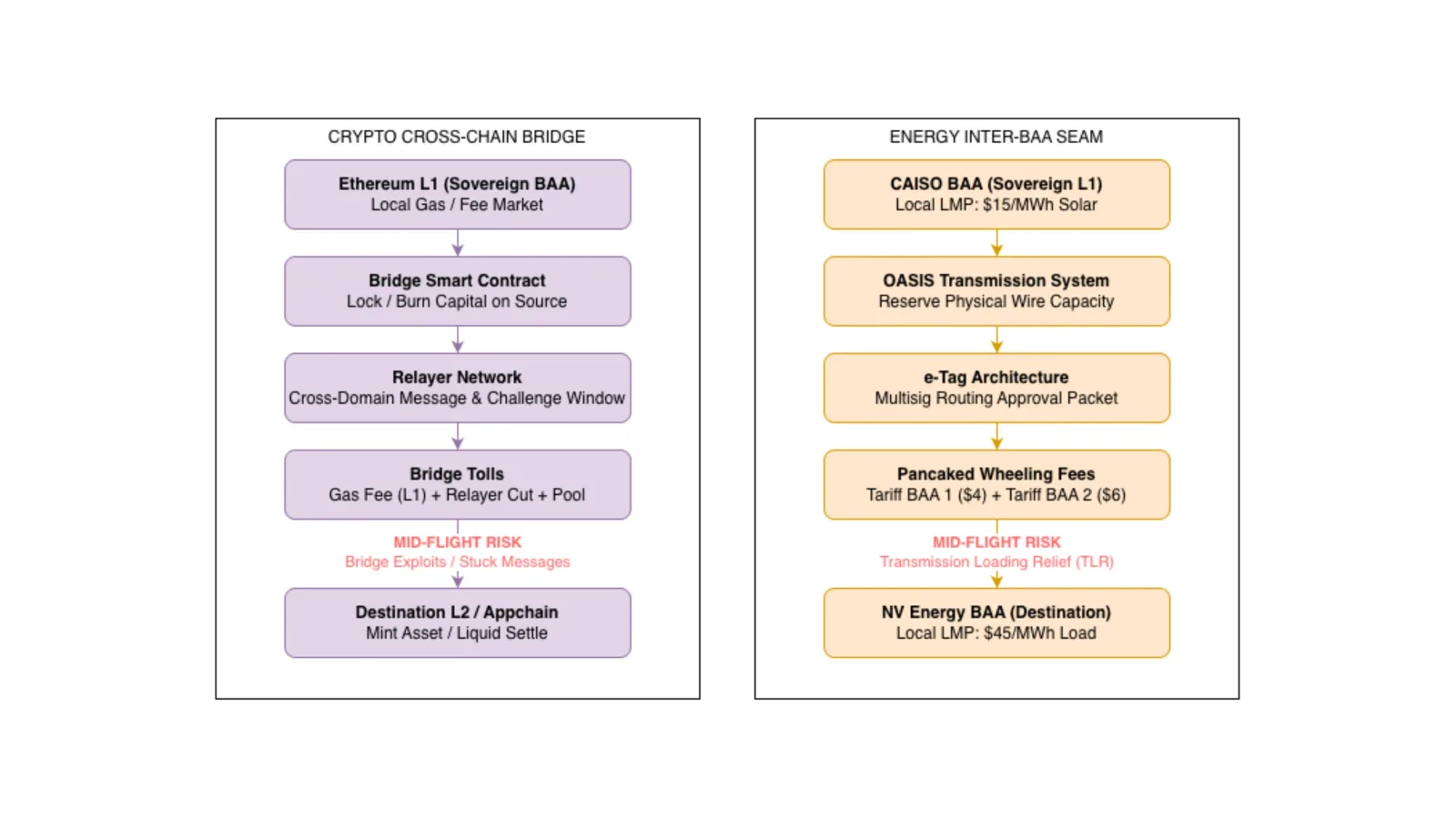
The 4-Stage Transfer Pipeline
- Source State Reservation (Bridge Vaults vs. OASIS Capacity): In crypto, capital is locked or burned in a smart contract vault on the source chain. In power, a trader logs into OASIS (Open Access Same-Time Information System) to reserve physical megawatt transmission capacity on the border wire connecting the two BAAs.
- Cross-Domain Messaging (Relayers vs. e-Tags): In crypto, off-chain relayers pass a merkle proof across chains. In power, the trader submits an e-Tag — an electronic manifest detailing the source generator, intermediate transit path, sink load, and MW profile. Every BAA along the path acts as a multisig validator that must digitally co-sign the e-Tag before power can flow.
- Stacked Friction (Bridge Tolls vs. Pancaked Wheeling): Routing transactions through multiple L2/L1 pools stacks gas fees and bridge cuts. Routing power across multiple BAAs stacks pancaked wheeling fees — each intervening utility charges its own independent transmission tariff, eroding the spatial spread.
- Mid-Flight Execution Risk (Stuck Messages vs. TLR Cuts): If a transmission line along the path hits thermal limits mid-hour, system operators issue a Transmission Loading Relief (TLR) order and cut the e-Tag mid-flight. If your source supply leg is already committed, you are left holding an unhedged imbalance — the energy market equivalent of a stuck bridge transaction during severe network congestion.
3. Order Matching: AMM Invariants vs. Nodal LMPs
Long before decentralized liquidity pools were written into smart contracts, MIT professor Fred C. Schweppe framed the core thesis of power market design in 1988:
“Electric energy must be treated as a commodity which can be bought, sold, and traded, taking into account its time- and space-varying values and costs.”
Fred C. Schweppe, Spot Pricing of Electricity, 1988
On an AMM like Uniswap, execution price is a function of mid-market price plus price impact (pool curvature) and base gas fees.
In energy markets, the price at any given transmission tower (node) is published as a Locational Marginal Price (LMP). The ISO calculates LMP using three explicit terms:
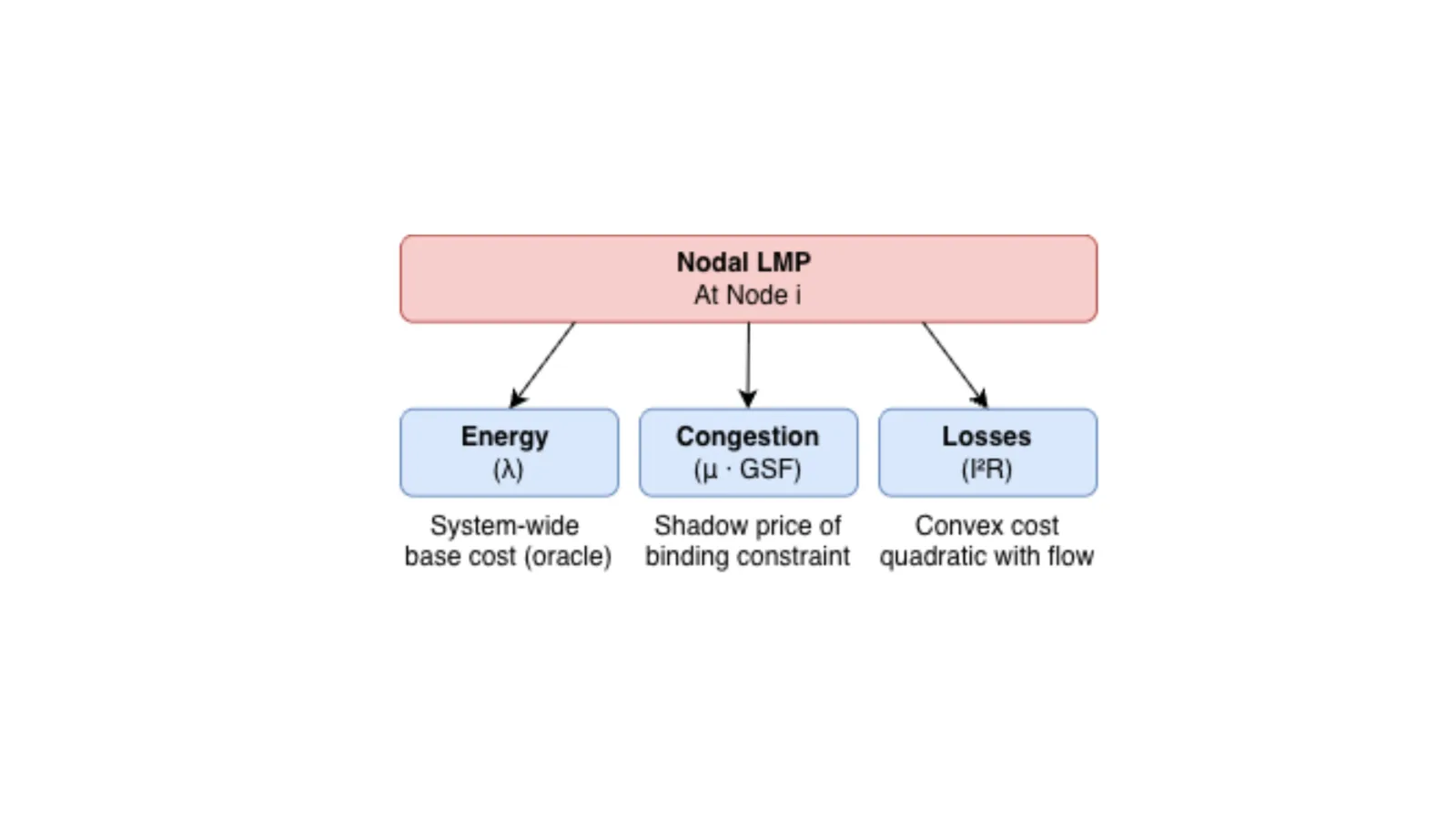
- λ (System Energy Price): The marginal cost to serve the next MW anywhere on the grid without constraints (the oracle/mid price).
- Congestion (μ · GSF): The shadow price (μ) of a clogged transmission line multiplied by how much power from Node i actually flows across that clogged line (Generation Shift Factor). This is the exact equivalent of EIP-1559 base fee spikes during high network demand.
- Marginal Losses (I²R): Physics dictates that heat loss across wires scales quadratically (I²R). Because it is quadratic, the marginal loss of pushing one extra MW is roughly twice the average loss, creating a convex cost-of-flow curve identical to AMM swap impact.
4. Arbitrage: Cross-DEX Arb vs. Virtual Bidding (INCs/DECs)
Crypto arbitrageurs force price convergence between two DEX pools (e.g., Uniswap vs. Sushiswap).
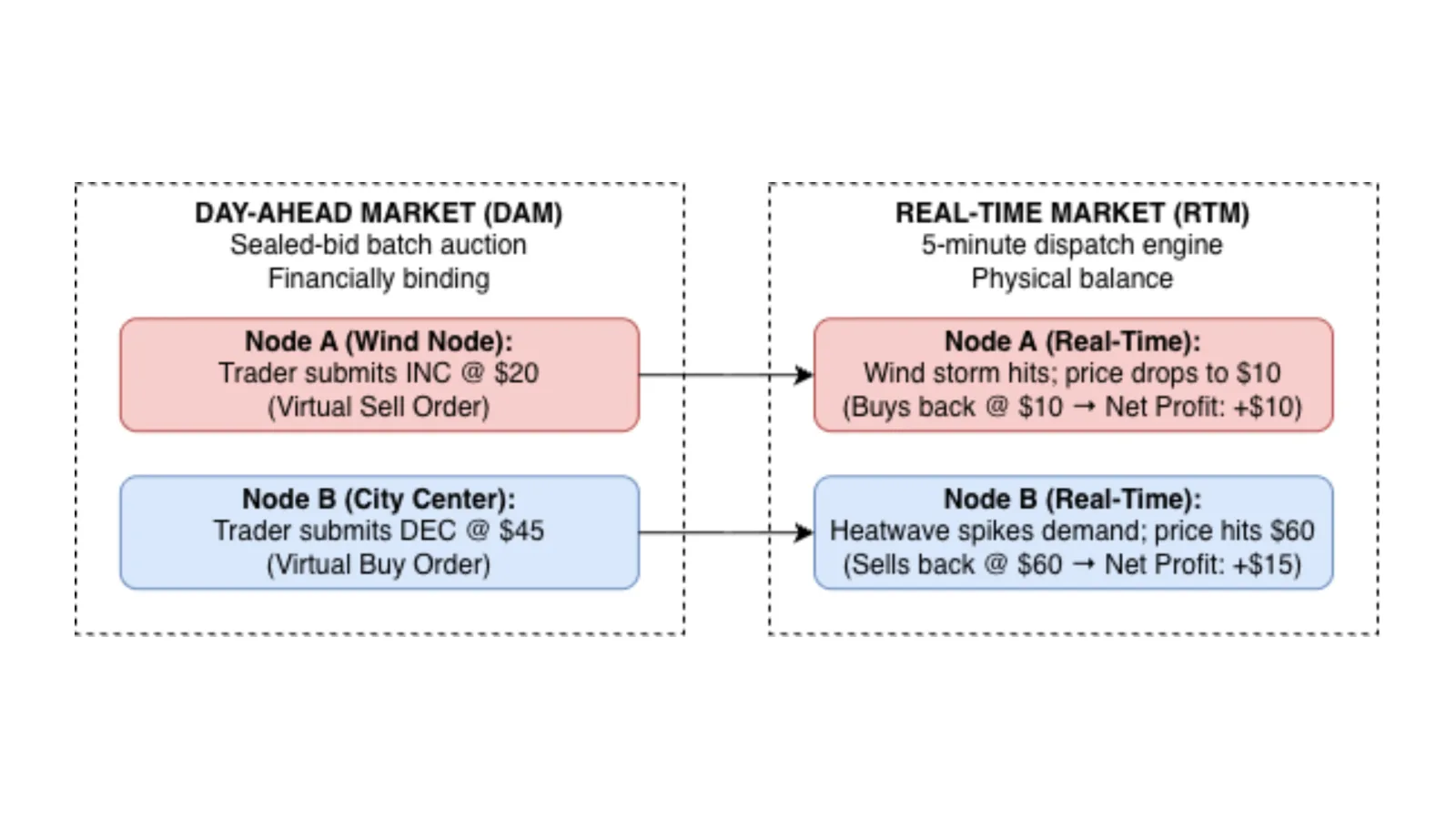
Energy traders execute Virtual Spread Trades to force convergence between two timeframes at the exact same location: the Day-Ahead Market (DAM) and the Real-Time Market (RTM).
The Mechanical Breakdown
- INC (Increment Offer): A virtual sell order in the Day-Ahead Market. You sell virtual power at the Day-Ahead price and automatically buy it back at the Real-Time price. You profit when DAM > RTM.
- DEC (Decrement Bid): A virtual buy order in the Day-Ahead Market. You buy virtual power at the Day-Ahead price and automatically sell it back at the Real-Time price. You profit when RTM > DAM.
Combining an INC at Node A with a DEC at Node B creates a virtual cross-node basis trade — buying low-cost generation in one area and selling high-cost demand in another without touching a physical megawatt.
5. Congestion Hedging: Gas Futures vs. FTRs / CRRs
In DeFi, if you know network traffic will spike tomorrow, you lock in gas futures or buy options on base fees to cap your execution costs.
In energy markets, traders use Financial Transmission Rights (FTRs) — called Congestion Revenue Rights (CRRs) in CAISO and ERCOT — to hedge or speculate on transmission line bottlenecks.
An FTR for the path from Node A to Node B entitles the holder to collect the Day-Ahead congestion price difference:
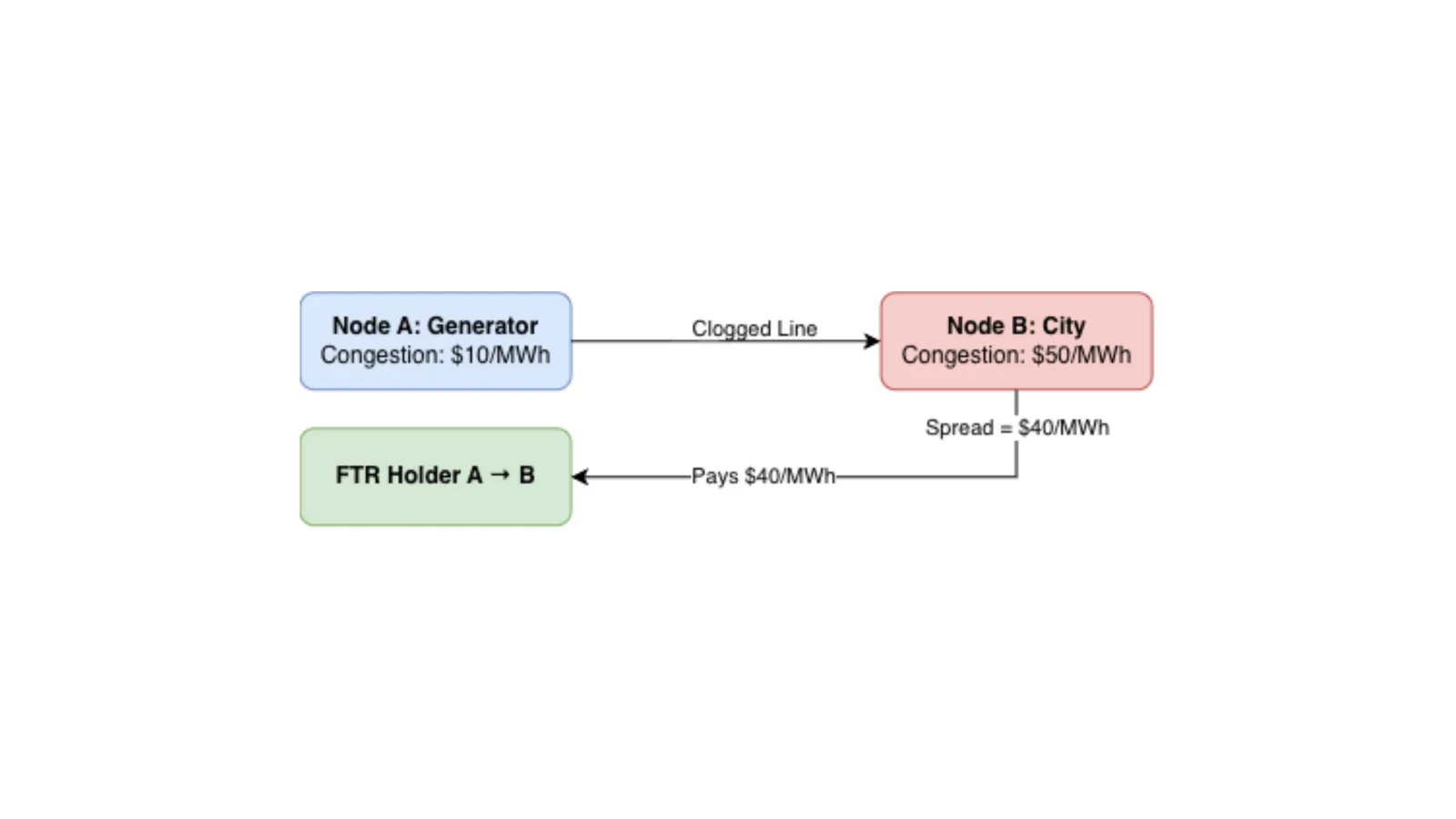
Physical generators buy FTRs to lock in delivery costs. Financial desks buy them in seasonal ISO auctions to speculate on weather events: if a heatwave clogs a path, the ISO pays the FTR holder a massive payout funded directly by the physical market participants paying congestion fees.
6. Physical Routing: AMM Multi-Hop vs. Loop Flows
When routing a swap through an aggregator, your trade might split across three liquidity pools. If other users move those pools while your trade is in flight, you experience routing slippage.
In power markets, this is governed by Kirchhoff’s Laws and is known as Loop Flow or Unscheduled Power Flow.
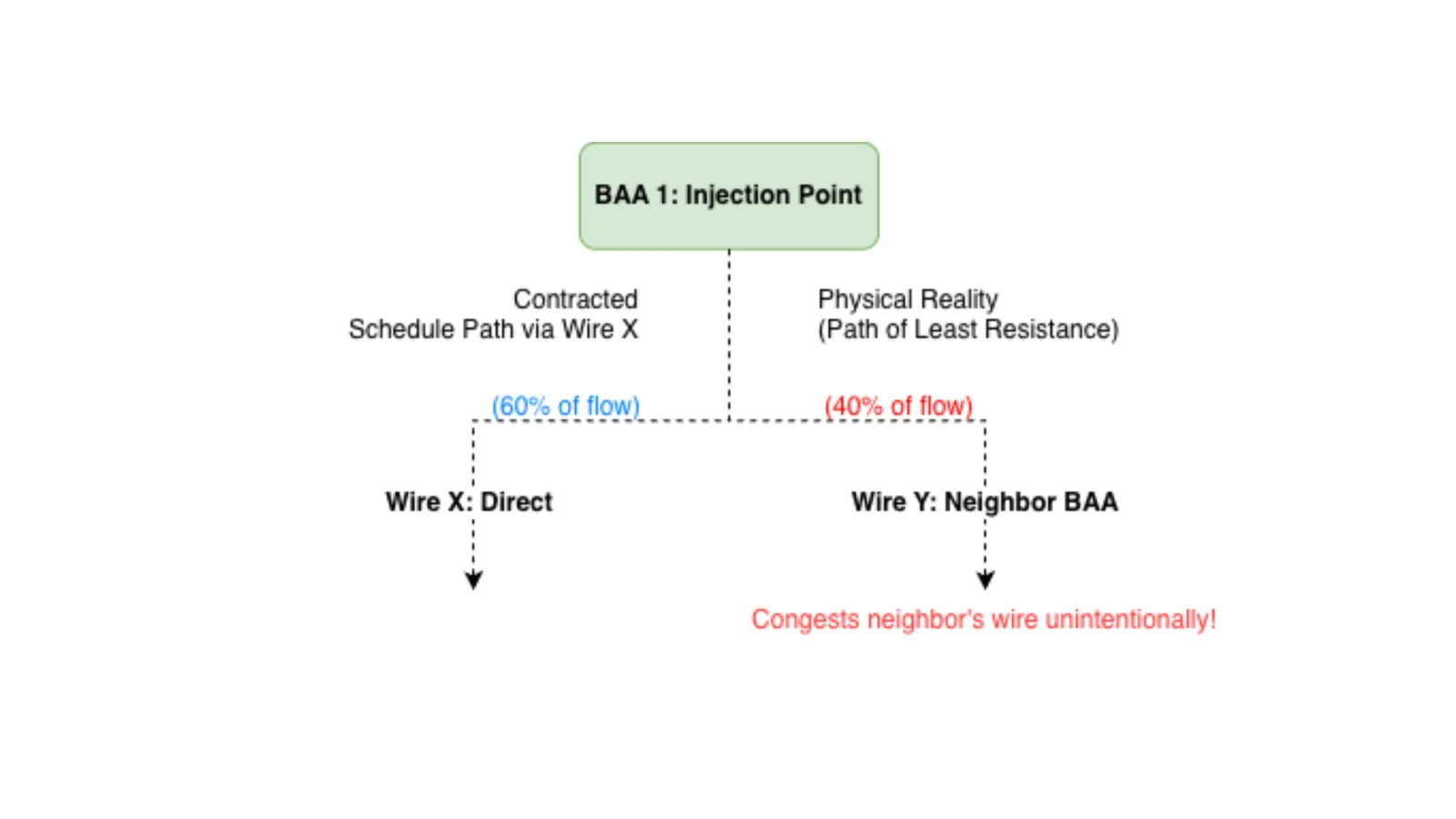
Electricity does not follow a paper contract. If a trader schedules 100 MW from BAA 1 to BAA 2 over “Wire X,” the electrons physically distribute across every interconnected path in the entire grid based on impedance (Power Transfer Distribution Factors, or PTDFs).
If a third party flips a switch three states away, power loops through your node, clogging your line and causing unexpected nodal price spikes. You scheduled path A, but physics executed path A + B + C.
7. Execution Engines: DEX Aggregators vs. ISO SCED
A DEX aggregator like 1inch uses graph optimization to split a trade across venues, minimizing price impact and gas fees.
An ISO uses an engine called Security-Constrained Economic Dispatch (SCED) to solve a linear programming problem every 5 minutes: minimize total generation cost across the entire grid while honoring thousands of physical line limits.
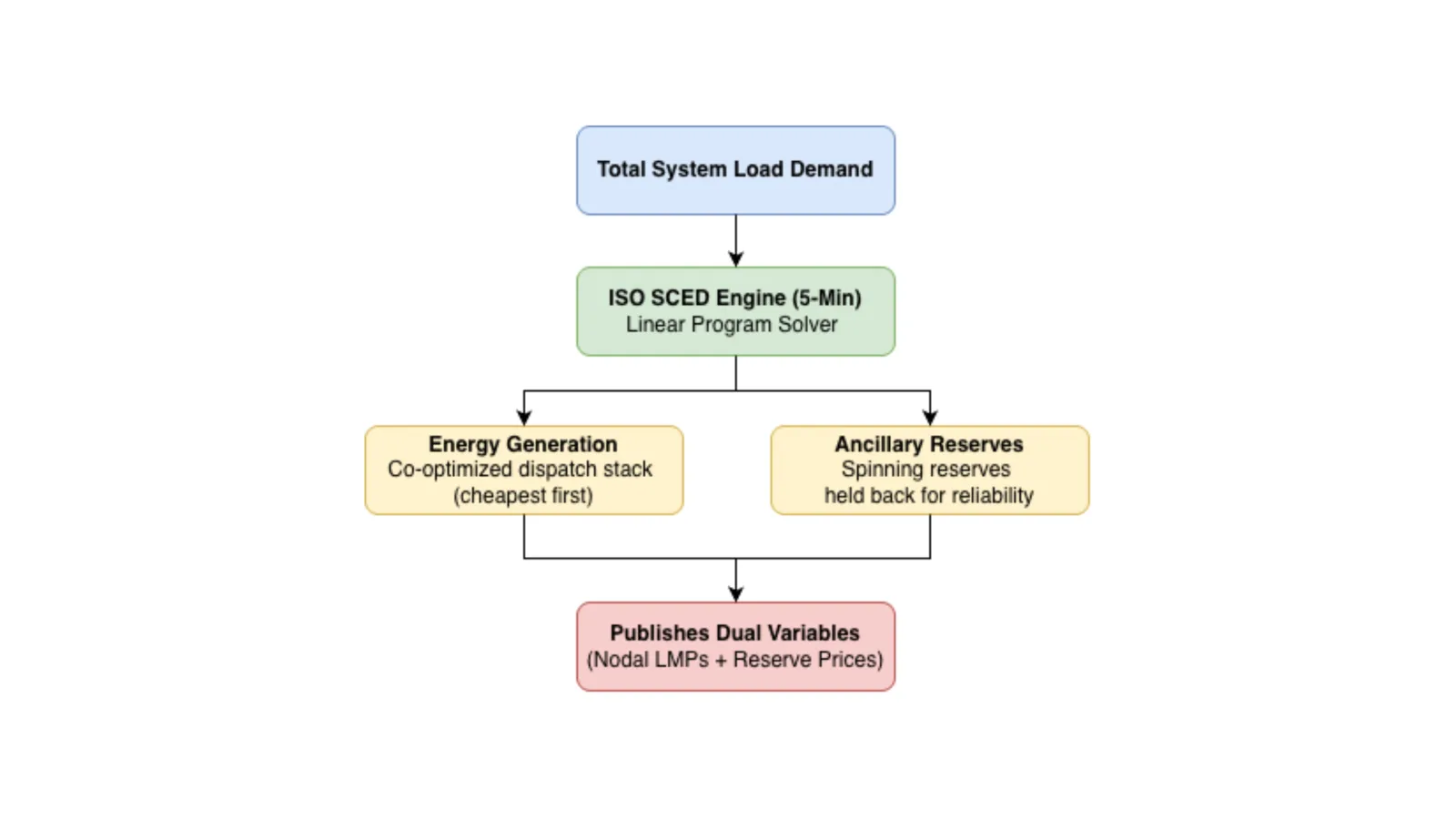
SCED co-optimizes Energy and Ancillary Services (Operating Reserves) in a single solve. If holding back a cheap gas turbine for backup capacity is more efficient than running it for energy, SCED calculates the opportunity cost and prices both products simultaneously.
(Note: PJM, MISO, and CAISO have co-optimized for years; ERCOT introduced real-time co-optimization with RTC+B in December 2025).
8. Latency Limits: Block Times vs. Generator Ramp Rates
In crypto, when market volatility hits, you are constrained by block times and mempool congestion. You cannot exit a position faster than a validator can mine a block.
In energy markets, the physical latency limit is a generator's Ramp Rate (measured in MW/minute).
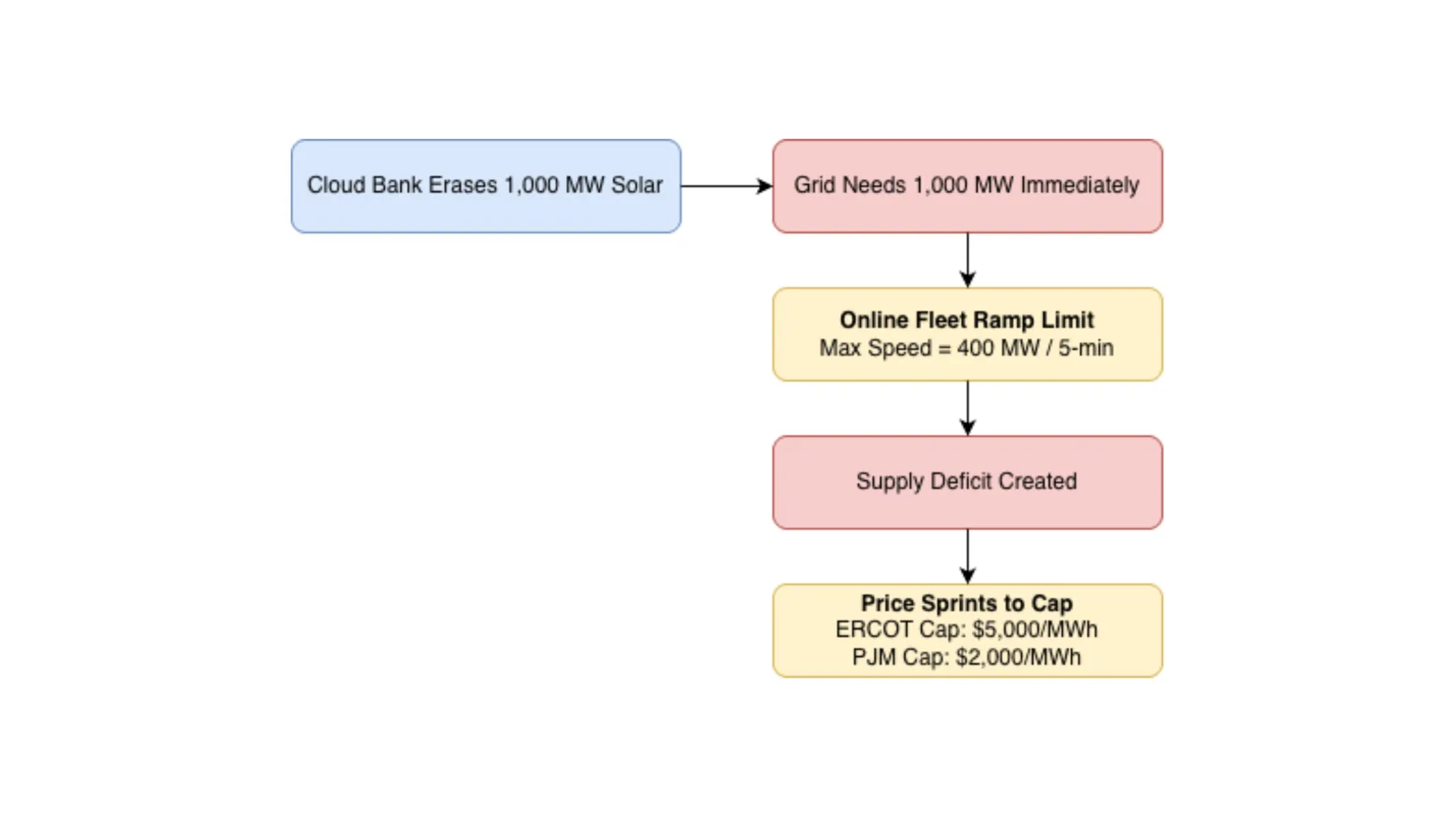
A nuclear plant takes days to adjust output; a combined-cycle gas turbine might ramp at 15 MW/minute.
When cloud cover suddenly wipes out 1,000 MW of solar output, the grid experiences a massive state transition. If the online fleet cannot ramp fast enough to fill the gap, the 5-minute SCED interval clears in severe scarcity — sprinting straight to administrative price caps ($5,000/MWh in ERCOT, $2,000/MWh in PJM).
This is the physical equivalent of a high-gas bidding war during a network liquidation cascade.
9. Protocol Limits: Max Gas & Slippage Caps vs. Virtual Position Limits
In DeFi, protocols implement maximum slippage bounds, per-block gas caps, and account rate-limits. If a whale tries to dump $50M through a thin Uniswap v3 pool, the router reverts the transaction or caps the fill to prevent total pool depletion and flash-loan manipulation.
In energy markets, ISOs enforce Virtual Bidding Position Limits and Credit Exposure Screens to prevent financial capital from overwhelming physical infrastructure.
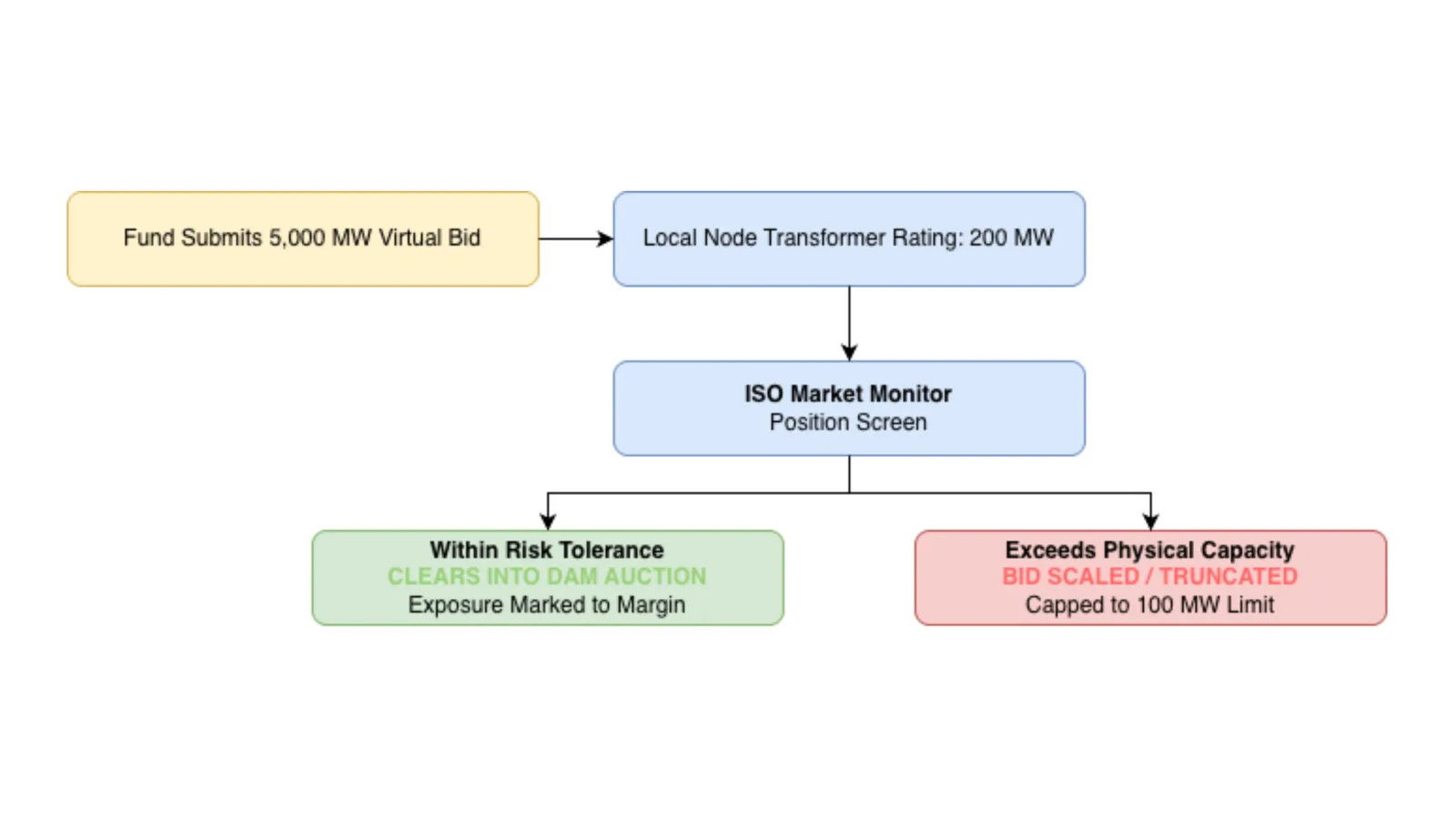
The Mechanical Safeguard
If a quantitative desk spots a modeling discrepancy at a tiny rural 138 kV substation node, throwing 5,000 MW of virtual DECs onto that node would force the clearing software to calculate absurd, unphysical shadow prices.
To prevent this, the ISO sets hard caps keyed to the physical capability of the underlying transformers and the participant's posted collateral:
- Nodal Caps: Virtual bids cannot exceed a fixed percentage of a node’s physical thermal limit or historical peak load.
- Credit Margin Calls: Virtual positions are marked against maximum potential Real-Time volatility. If Real-Time prices move against the position overnight, the ISO issues an immediate margin call — the energy equivalent of a DeFi maintenance margin liquidation.
10. Atomic Trades: Flash Loans vs. Up-To-Congestion (UTC) Trades
Cross-chain trades carry leg risk: if your buy order lands on Ethereum but your sell order fails on Solana, you are left holding unhedged directional exposure.
In PJM, traders use Up-To-Congestion (UTC) trades to eliminate entry leg risk.
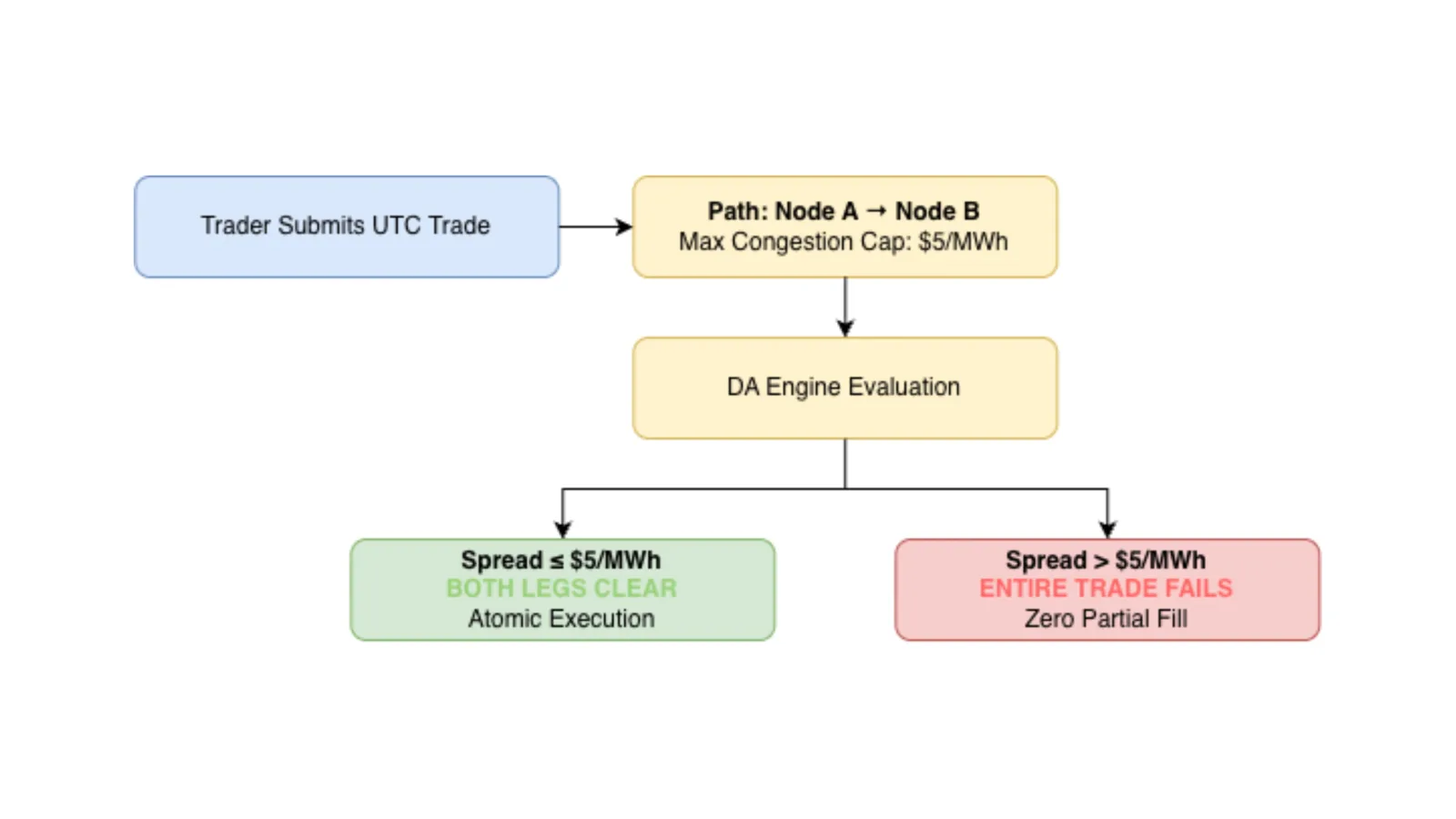
A UTC is a spread bid between a source node and a sink node with an explicit ceiling. If the Day-Ahead congestion spread is within your cap, both legs clear simultaneously. If the spread exceeds your cap, nothing clears.
This provides atomicity at inclusion, exactly like a Flashbots bundle or flash loan.
(Note: While entry is atomic in the Day-Ahead market, the trader remains exposed to Real-Time spread changes).
11. State Drift: Chain Reorgs vs. Inadvertent Interchange
In crypto, transient network partitioning causes temporary blockchain forks (reorgs). Two nodes briefly hold divergent views of state until consensus aligns them onto a single canonical chain.
In physical power grids, state drift between adjacent Balancing Authority Areas (BAAs) is called Inadvertent Interchange.
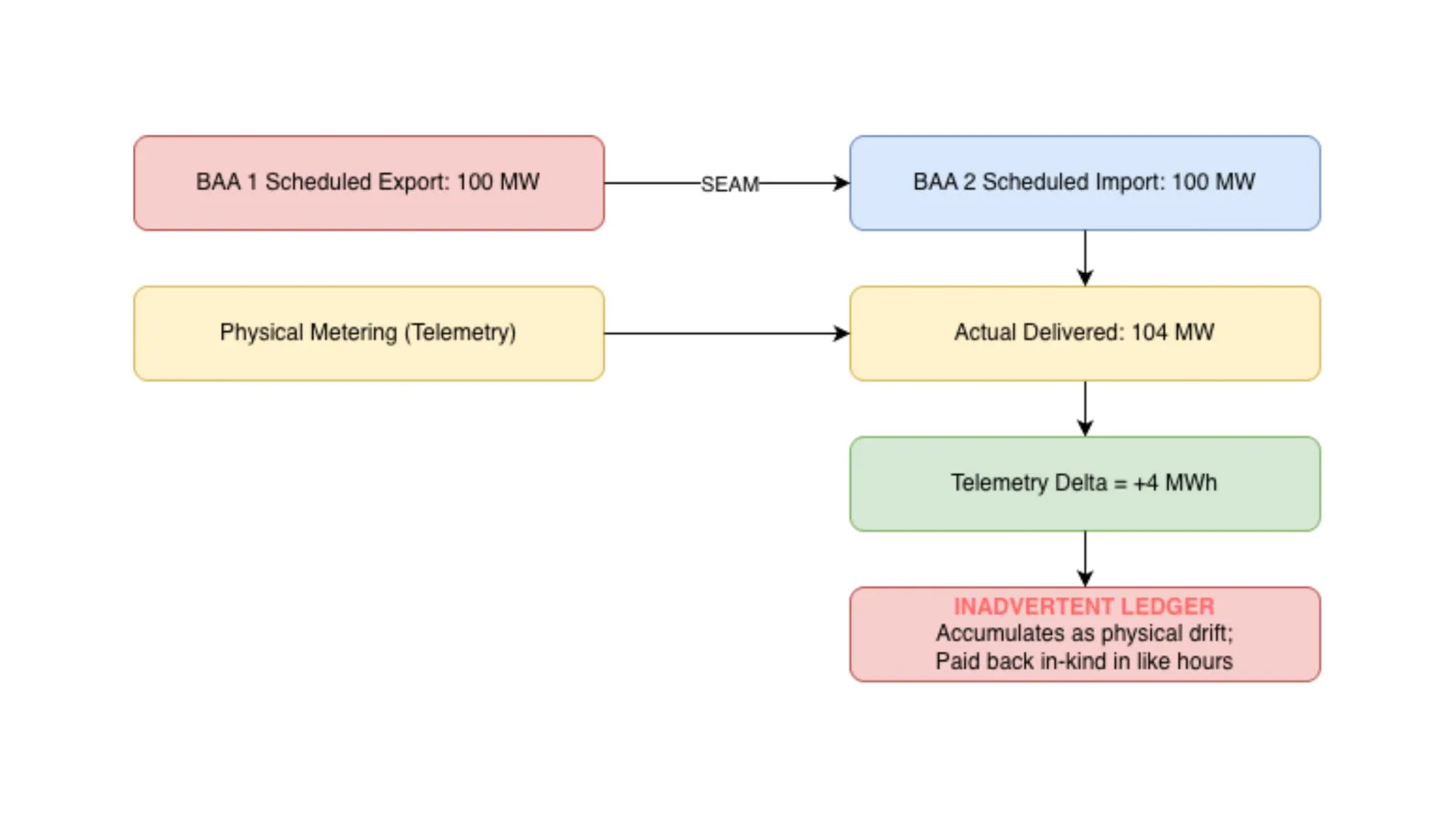
The Physics of Telemetry Drift
Despite atomic GPS clocks and SCADA systems, frequency fluctuations at 60 Hz mean physics rarely delivers exact scheduled contract numbers down to the single electron. If BAA 1 schedules 100 MW to BAA 2 over an hour, thermal expansion, voltage droop, or generator inertia might cause 104 MWh to actually cross the wire.
Unlike financial markets that settle instant cash for telemetry noise, the power grid uses an optimistic state ledger:
- In-Kind Payback: The +4 MWh surplus is logged in an administrative imbalance ledger.
- Reconciliation Rules: BAA 1 does not bill BAA 2 immediately. Under NERC reliability standards, the 4 MWh must be paid back in-kind during future hours with equivalent operating regimes (e.g., off-peak for off-peak, on-peak for on-peak).
It is physical reconciliation for state desynchronization — forcing real-world assets to align back to consensus truth over time.
12. Paid Readiness: PoS Staking & Slashing vs. Spinning Reserves
In Proof-of-Stake protocols, stakers lock up capital to validate state transitions. They earn a steady yield for standing ready, but face slashing (loss of principal) if their validator goes offline or double-signs a block.
In energy markets, power plants earn yield through Ancillary Services, specifically Spinning Reserves.
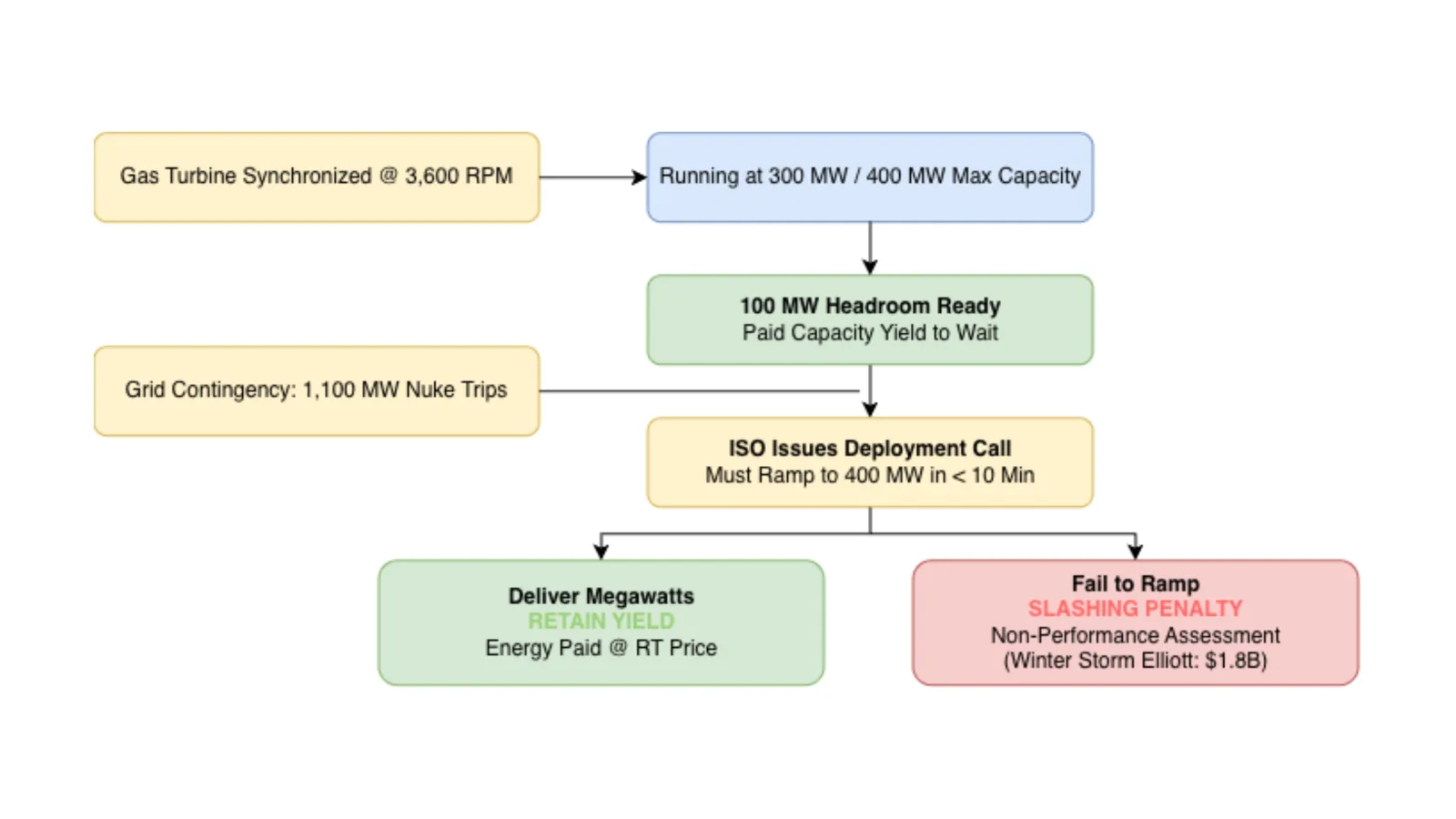
The Staking Yield Architecture
A spinning reserve is synchronized headroom: a generator already online and phase-locked to the 60 Hz grid, but operating below its maximum capability (e.g., spinning at 300 MW on a 400 MW unit).
The ISO pays the plant operator a capacity payment ($/MWh) purely for holding that 100 MW in active readiness — the exact equivalent of staking yield for securing blockspace.
Real-World Slashing: Winter Storm Elliott
If a major nuclear unit trips offline, the ISO issues an emergency reserve call. Spinning reserves must ramp to full output within 10 minutes. If a plant fails to deliver when called, the slashing penalties are catastrophic.
During Winter Storm Elliott (December 2022), frozen fuel lines caused dozens of thermal units in PJM to trip when called upon. PJM assessed over $1.8 Billion in capacity non-performance penalties on non-delivering generators — the largest single slashing event in energy market history.
13. Funding Dynamics: Negative Funding Rates vs. Negative LMPs
When crypto perpetual futures skew heavily short, the funding rate goes negative: short traders pay long traders a fee every 8 hours to maintain their positions.
In energy markets, LMPs frequently go negative (dropping to floors of −$251/MWh in ERCOT or −$150/MWh in CAISO).
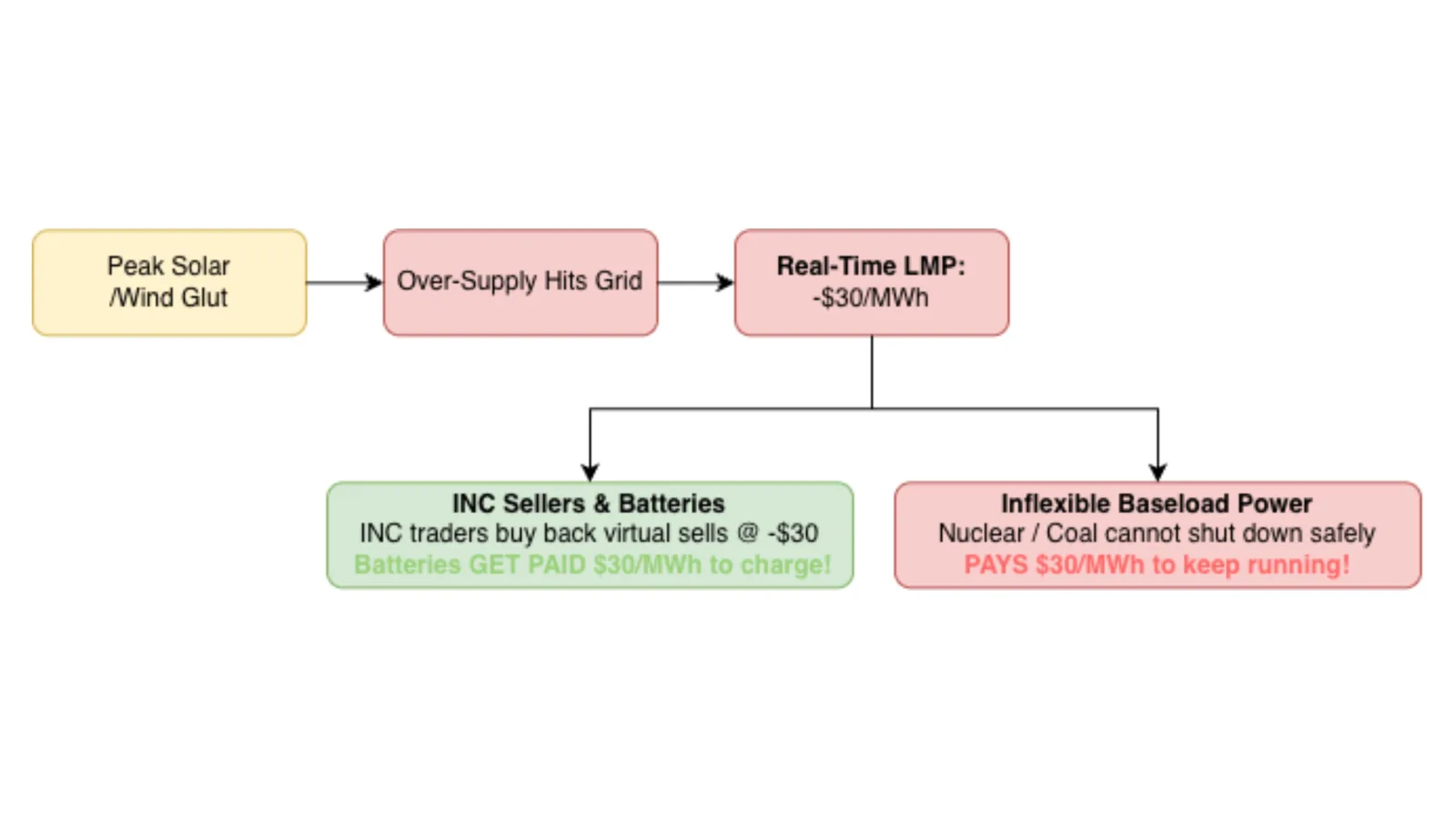
Why Prices Go Negative
- Production Tax Credits (PTC): Wind farms receive federal tax credits (~$27/MWh generated). Bidding −$20/MWh still yields a net +$7/MWh profit.
- Physical Inflexibility: Thermal plants take hours to shut down and restart. Paying $30/MWh to stay online for two negative hours is cheaper than paying $100,000 in mechanical restart costs.
Who Collects the Yield?
- INC Sellers: Sold Day-Ahead at +$20, buy back Real-Time at −$30 → +$50 net profit.
- Battery Assets: They are literally paid cash to charge their cells.
14. Capital Efficiency: Yield Looping vs. Battery Arbitrage
In DeFi, users “yield loop” — depositing ETH, borrowing stablecoins, buying more ETH, and re-depositing to multiply exposure. The loop remains profitable as long as Yield > Borrow Cost.
Grid-scale batteries execute a physical carry trade across intraday spreads (Top 2-hour or 4-hour peak vs. bottom trough).
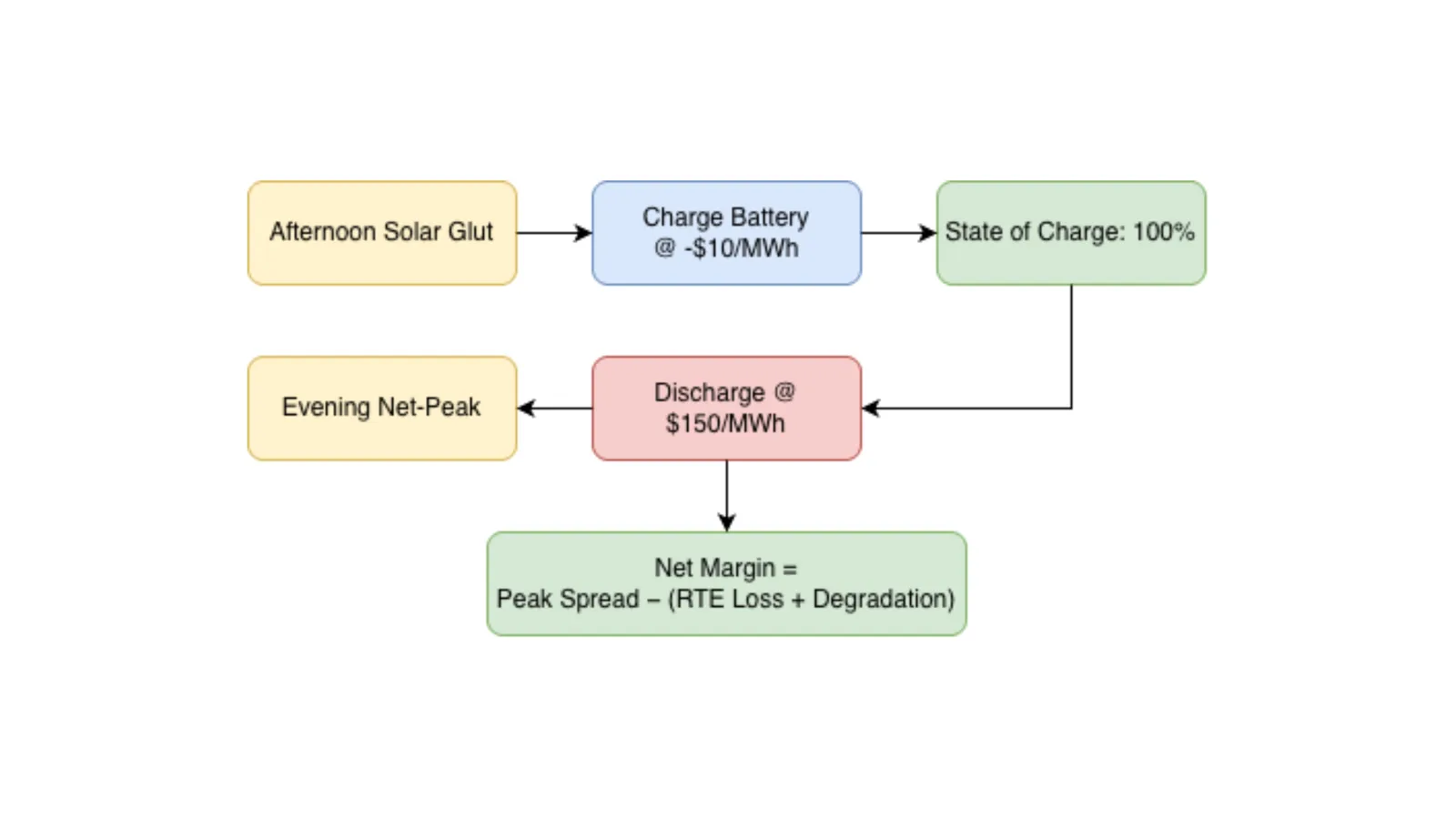
A battery's “borrow rate” is determined by physics and hardware:
- Round-Trip Efficiency (RTE): ~85% of energy is lost as heat during charging and discharging.
- Cell Degradation: Every charge cycle degrades battery life, adding a marginal hardware cost per MWh cycled.
A battery loop is profitable if and only if:
If line congestion isolates a battery’s node during peak hours, its energy becomes physically trapped — the exact equivalent of a smart contract lockup during a market crash.
15. Market Extraction: MEV Sandwiches vs. Capacity Withholding
An MEV searcher frontruns a large AMM order in the mempool, pushes price impact higher, and backruns the victim to capture the spread.
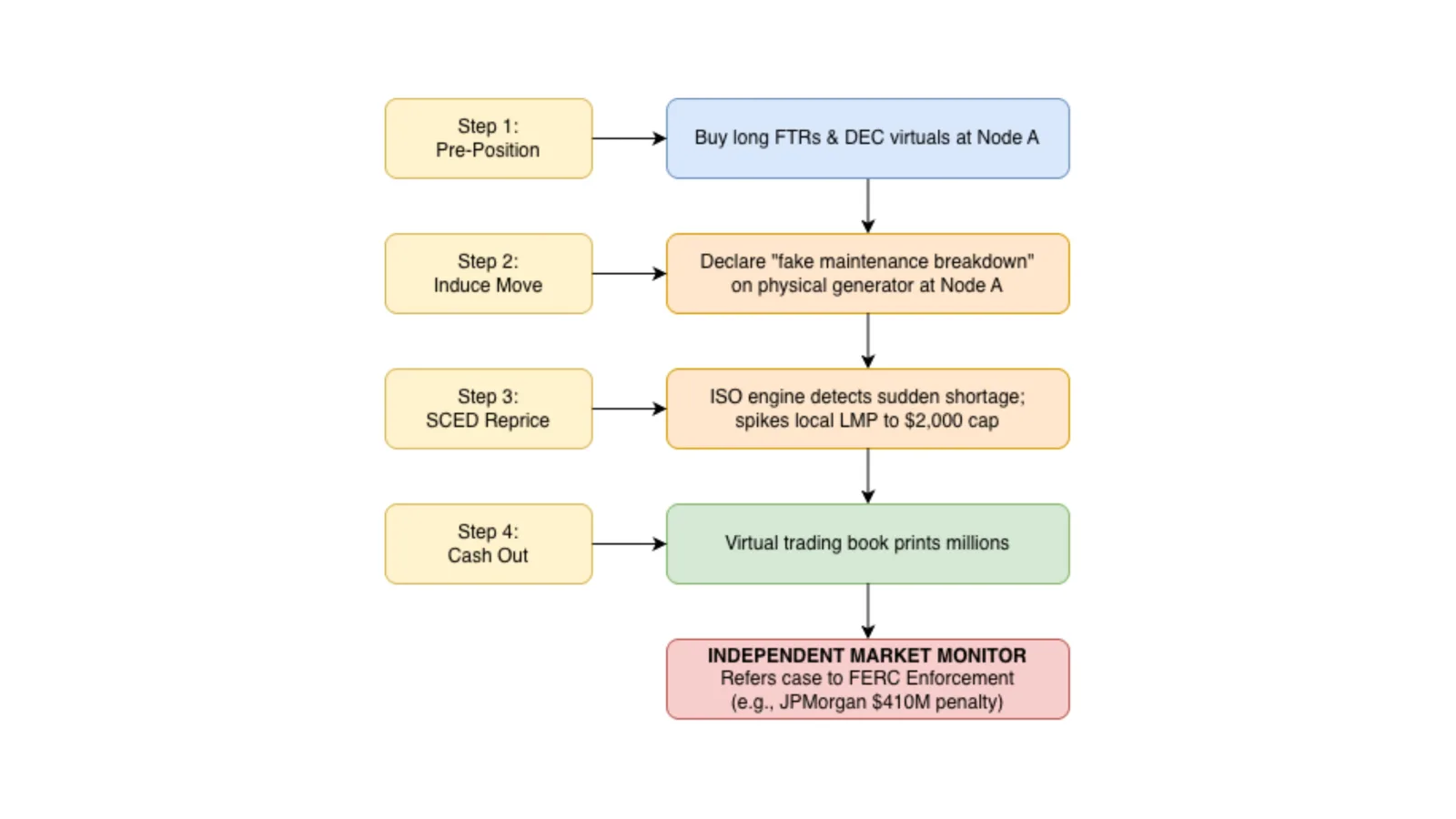
Historically, predatory desks executed a physical version of this strategy using Strategic Capacity Withholding.
The Difference in Enforcement
In crypto, MEV extraction is permissionless software execution.
In power markets, the Independent Market Monitor (IMM) runs automated behavioral models over every bid. The IMM continuously screens for physical and economic withholding. When anomalies are detected, the IMM refers the desk to FERC’s Office of Enforcement, where penalties run into hundreds of millions of dollars.
Where the Analogy Breaks
While the mathematical duals match, four real-world differences govern energy trading:
- The Sequencer Has a Legal Monopoly: There is no permissionless validator set. A single regulated ISO runs the clearing engine under FERC jurisdiction.
- Sealed-Bid Day-Ahead Auctions: Power markets clear billions in day-ahead volume via sealed batch auctions — an anti-MEV architecture CoW Swap reinvented two decades later.
- Kirchhoff Overrules Governance: Governance votes cannot amend Ohm's Law. If a line overloads, physical thermal limits trip breakers regardless of contract schedules.
- No Forking: Load must be served in real time at 60 Hz. State transitions cannot revert, and short obligations settle in mandatory fiat cash.
The Converging Frontier
In her book The Grid: The Fraying Wires Between Americans and Our Energy Future, Dr. Gretchen Bakke wrote that
“The grid is awesomely complex. It is the largest machine in the world.”
Gretchen Bakke, The Grid
What crypto quants and MEV searchers are discovering today is that this machine is also a massive, continuous order book.
As AI compute clusters devour gigawatts of power, crypto miners transform into flexible grid-balancing loads, and battery storage assets deploy autonomous algorithmic bidding, the boundary between software state machines and physical infrastructure is dissolving.
If you can quantify MEV, model solver routing, or trade convex price impact on an AMM, you aren't just a crypto trader — you already possess the quantitative toolkit required to trade the global energy transition.
The grid was always an exchange. Now, code is learning how to run it.