
August, 2026
The Last Secret Pipeline
Posted by Wattness
Every era of commodity trading was made by someone who understood a physical constraint before anyone else. What happens when the constraint moves inside the machine, and the edge stops being secrecy and becomes proof.
A man stands at the Soviet border and he is shaking.
He has reason to. He was a prisoner of war in the east, and the memory has not faded the way memories are supposed to. He is going back voluntarily, which is a thing almost nobody does, and he is going for a reason so mundane it is almost embarrassing: his fuel distribution company in Hamburg is losing money, and he needs oil, and the people who have oil will not sell it to him.
His name is Theodor Weisser. The company is one he did not found so much as inherit by purchase — a dormant shell called Marquard & Bahls, bought a few years earlier largely because it held an import licence, which in an occupied country was worth more than the business attached to it. The occupying authorities would not permit a new energy company. So he bought an old one that had stopped trading and put his own trade inside it.
In Moscow he gets a dinner with a man who runs the agency that sells Soviet oil abroad. The dinner works. Weisser comes home with a deal, and with something more consequential than a deal: he becomes the first independent trader to buy crude outside the network of the majors that controlled almost all of it. The majors respond exactly as you would expect. They stop doing business with him.
That is where the modern commodity trade begins — not with a price, not with an insight about supply and demand, but with a man crossing a border nobody else would cross, to build a route nobody else had built.
The pattern holds for seventy years, and it is worth stating precisely, because the precision is the point.
The merchant's edge was never abstract financial cleverness. It was this: understand a physical constraint before anyone else does, then build the operational rail that crosses it. The constraint was always somewhere in the world — a border, a canal, a refinery, a hull. The rail was always a physical thing you could point at.
Consider the second era. The canal closes. Not the famous closure that most people half-remember, the one where a president nationalised a waterway and three armies arrived — that one lasted a few months. The closure that mattered came after a later war, and it lasted the better part of a decade. Suddenly the shortest path from the Gulf to Europe does not exist. Oil that has to reach Rotterdam must go around a continent.
So two governments who are not supposed to be friendly to each other sign a secret agreement to build a pipe across a desert, from a port on one sea to a port on another. It bypasses the canal entirely. Within about a year and a half, oil is moving through it. The arrangement is concealed so thoroughly that the company operating it sits outside most of the ordinary law of the country it runs through, and disclosing its workings carries a prison term. Cargoes are dispatched under false destinations.
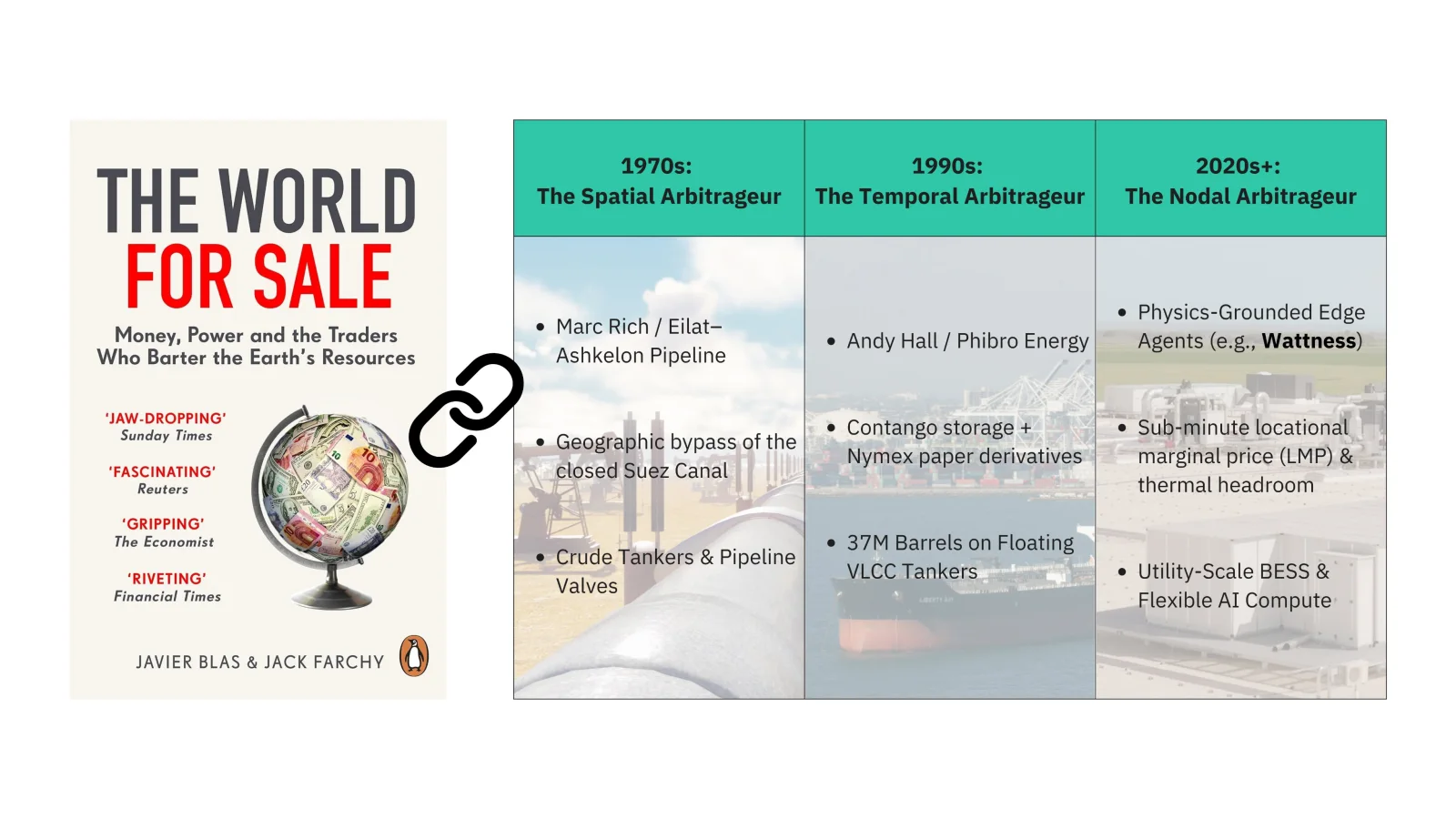
Into that arrangement steps a trader who had learned the business at a house called Philipp Brothers. He had left it to start his own firm, and he understood something the majors' organisation charts could not accommodate: that a producer who cannot be seen selling to a particular buyer will pay handsomely for a middleman who can stand between them. He moved Iranian crude through that desert pipe to European markets. Later, after a revolution turned the two partner governments into enemies, oil kept moving, and he kept moving it.
His name was Marc Rich. Hold that name; we will come back to it, and the coming back is the point of this essay.
The third era is the one where the physical and the financial finally admit they are the same thing.
By the eighties an exchange in New York had begun trading crude oil futures, and a barrel could now exist twice — once as liquid in a tank and once as a contract in a pit. Most people treated these as separate worlds. One trader did not.
He worked at Phibro, which was what Philipp Brothers had become — the same house that had trained Rich a generation earlier, now the trading arm of an investment bank. In the summer that Iraq's tanks were massing on the Kuwaiti border, crude was cheap and the forward curve was upward-sloping, which meant a barrel bought today and sold for later delivery paid for its own storage and left something over. He chartered tankers. He filled them. He hedged the price forward and let them sit.
Then the tanks crossed, and the price went vertical, and what had been a modest and careful carry trade became something else entirely: he sold the physical oil into a spot market that had lost its mind and bought back the hedges he had sold when oil was cheap. His name was Andy Hall, and the market took to calling him God, which tells you something about the market's sense of proportion and something about the size of the trade.
What Hall understood was not that war was coming. Plenty of people suspected war was coming. What he understood was that a chartered hull and a futures contract are two spellings of the same word, and that if you own the storage you own the option.
Three men, three eras, one shape. Weisser understood a border. Rich understood that a pipe could substitute for a canal. Hall understood that a tanker could substitute for a warehouse and that a warehouse is a derivative. Each of them saw a physical constraint first and built the rail across it, and the rail was where the money was — not the view, not the forecast, the rail.
The frontier has moved, and it has moved somewhere specific.
The most physically constrained, most temporally unforgiving commodity market now operating is not oil. It is not copper or gas. It is wholesale electricity — and it is worth being concrete about why, because the reasons are not the ones people assume.
Start with location. In oil, spatial arbitrage is measured in oceans; the spread between two places is a function of freight and time. On a power grid, price diverges between points that are a short drive apart, because the wires between them have a limit and the limit binds. Generation trapped behind a constrained line can clear below nothing — the owner paying to deliver, because switching off costs more than paying — while a load centre not far away clears at a price that would be a scandal in any other market. The constraint is not distance. It is a piece of hardware with a rating, and the rating is thermal, and thermal ratings depend on the weather.
Then take time, and here the analogy to the tanker breaks in a way that matters more than anything else in this essay.
Hall's crude waited without complaint. Oil in a hull is oil in a hull; it does not become less oil for having been stored. It has no opinion about how long it sits or how often it moves. This is why the carry trade works: the commodity is indifferent to the strategy imposed on it.
A battery is not indifferent. Every discharge decision consumes some portion of the asset's remaining life, and the amount consumed depends on how full it is, how warm it is, how hard it has been worked lately, and how fast you are asking it to move. There is no storing electricity the way you store crude. There is only running a machine that degrades, and choosing when to spend it. Sizing an arbitrage on a battery while ignoring what the cycle costs the battery is chartering a tanker that dissolves while you sail it.
And finally the clock. Oil settles against cargo windows measured in months. Wholesale power dispatches every few minutes and settles on a slightly slower clock than it dispatches — a distinction that sounds pedantic and is in fact where a great deal of confusion lives — with frequency response running underneath at a cadence below human perception. There is no trading desk, however good, that operates inside that window. There is no spreadsheet that does either. Whatever decides has to be a machine, and the machine has to be right about physics.
So the raw material of a new era is all present: a binding physical constraint, a market that prices it locationally, and a clock that has collapsed past the point where humans can be the ones deciding. On the face of it the lineage continues. The nodal arbitrageur follows the temporal arbitrageur follows the spatial one, and the same kind of person wins.
Except that the lineage breaks, and it breaks on the thing nobody puts in the diagram.
Return to Marc Rich.
He was indicted by a federal grand jury on a long list of counts — tax evasion, fraud, racketeering, and trading with Iran while Americans were held hostage in Tehran. The prosecutor called it the largest tax case in the country's history to that point. Rich left for Switzerland ahead of it and stayed there, on a most-wanted list, for the better part of two decades, protected by a treaty that did not treat tax offences as grounds for extradition. His companies pleaded out and paid. He himself was pardoned on a president's final day in office, which produced a congressional investigation, a bipartisan uproar, and an eventual admission of regret from the man who signed it.
Weisser was not a criminal, but he was punished all the same: the majors closed their books to him for the offence of trading outside their club.
This is not a moral aside. It is the mechanism. Look again at what the edge actually consisted of in each case.
The pipe across the desert was worth something because it was secret. Its value came from the fact that a producer could sell without being seen to sell and a buyer could buy without being seen to buy. The concealment was not incidental to the trade; the concealment was the trade. Strip the secrecy and there is no premium, because there is no reason to need a middleman.
Weisser's advantage was that nobody else had been to Moscow. Hall's was that he had assembled a picture of the market — inventories, freight rates, the shape of the curve, the mood at the border — that others had not, and could act before it became consensus. In every case the edge was an information asymmetry, and an information asymmetry is by definition something the other side cannot check.
That is the era's real signature. The merchant's advantage was that nobody could verify him.
And that is why the inheritance does not transfer.
The world these men operated in has been steadily replaced by one built on mandated visibility. Positions are reported. Trades are surveilled. Market-manipulation regimes exist specifically to catch the behaviours that used to be called ingenuity. The large houses that grew out of this history have spent recent years settling enforcement actions that would have been unremarkable business practice in the era the history describes. This is not a complaint and not nostalgia. It is a description of the operating environment, and any thesis about who wins next has to be built inside it rather than around it.
But there is a deeper reason the old edge is unavailable, and it is physical rather than legal.
The constraint that matters on a grid is not a border, a canal, or a hull. It is not somewhere in the world where you could go and see it and build a route around it. It is inside the machine: the state of charge, the thermal margin, the accumulated wear, the fraction of a computing load that can genuinely be deferred at this exact moment rather than in principle. It is a state, and it changes minute by minute.
And here is the thing that makes it different in kind from every constraint in the history above. Nobody can see it from outside. The market operator cannot see it. The counterparty cannot see it. The system's models do not contain it. Two batteries with identical connection capacity on paper — the same figure on the same plate — can be completely different machines at the same instant, one able to deliver for hours and one about to throttle itself to avoid damage, and no document distinguishes them.
Which means the asymmetry has not disappeared. It has inverted.
In the old world, the merchant knew something the market could not see, and profited by acting on it. In the new world, everyone holds something the market cannot see — their own machine's true condition — and the market has no way to tell which of them is telling the truth.
This is not a hypothetical. It is the live design problem in every proposal for handing out scarce grid capacity, and it has a shape that anyone who has read about commodity trading will recognise instantly.
Where access to constrained headroom is allocated in proportion to what each participant declares it can do, declaring generously is not punished. It is rewarded. The member who claims a large flexible load it never intends to give takes a bigger share of every tight interval, and the cost falls precisely on the members who described themselves accurately. Honesty is taxed. This is not a flaw anyone designed in; it is what proportional allocation over self-reported quantities does, in any market, in any century.
And it fails at the worst possible moment. Electricity outcomes are not spread evenly across a year. A handful of scarcity intervals carry nearly all of the consequence, and the thousands of ordinary hours are, for this purpose, weather. A declared capability that averages beautifully through a mild season and fails on the one afternoon the system is short has told you nothing you needed to know. The claim looks exactly like capability right up until the constraint binds — and the constraint binding is the only moment that was ever the point.
There is a further wrinkle that no participant can see alone. Assets across a region share weather, share ambient temperature, and share one price signal that tells them all to do the same thing at the same instant. So the thresholds at which they each throttle themselves cluster. Machines that look independent on a map are, in the intervals that matter, one machine wearing many faces — and they will fail together, for the same physical reason, which no declaration mentioned.
So what is the rail?
Weisser built a trade route. Rich used a pipe. Hall chartered a fleet. Each rail was the thing that made the constraint crossable. The rail for this era is not made of steel, and it is duller than any of theirs, and I think it is the correct answer anyway.
The first piece is a model that sits at the asset and reads it rather than assuming it. State of charge, wear, thermal margin enter the decision directly rather than being bolted on afterward, so that the cost of a discharge already contains the life it consumes. Deterministic and inspectable: the same machine in the same state produces the same decision, and anyone can open it and see why. Not a forecast. Not a story about the future. A statement about the present that can be checked against the hardware. It is worth noting that the market itself has begun moving this way — the Texas system's most recent redesign now reads a storage asset's reported state of charge as a live constraint on what it will instruct that asset to do.
The second piece is that this model has to arrive where the asset already lives, speaking the schema its operators already use, rather than demanding they rebuild around it. The distribution layer is never the product.
The third piece is the one this whole essay has been walking toward. The decision has to be verifiable — reconstructible afterward by somebody who was not present when it was made. Not because anyone is presumed dishonest, but because a market in which every participant grades their own homework will be gamed, and will be gamed hardest exactly when the stakes are highest.
From verification comes the only honest fix for the declaration problem, and it requires no price and no penalty schedule. Weight each participant's claim by its own measured history — what it actually delivered, when it was actually called, against what it said it would deliver. Inflate the claim and the multiplier falls and the inflation cancels itself. The allocator still runs a simple proportional rule; it simply runs that rule over demonstrated capability rather than stated ambition. A newcomer starts neutral and earns standing by performing.
I should be exact about status here, because the whole argument depends on exactness. That mechanism is a proposal — published into an open standards process, offered for others to attack. It is not a rule in force anywhere. The state-of-charge-aware dispatch is live; the scoring is a design contribution. Confusing the two would be the precise error this essay exists to argue against.
The fourth piece is that all of it must exit as ordinary artefacts — the offer curves, telemetry and settlement files a control room already knows how to accept. No tariff rewritten. Nothing anyone has to be taught to read. The proof travels alongside the offer; it never sits between the asset and the market.
Which brings us to what has actually changed, underneath the technology.
For seventy years the merchant's advantage was that he could not be checked. The pipe was secret, the counterparty was undisclosed, the position was invisible, and the profit lived in the gap between what he knew and what anyone could confirm. That world produced extraordinary operators and it produced indictments, exile, and pardons, often in the same person, and the two were not separable outcomes of a single business model.
The advantage now available is the opposite one. It is not knowing something others cannot see. It is being able to demonstrate something others could otherwise not verify — because in a market where every participant declares its own capability, and where nobody can see inside anyone else's machine, the scarce thing is not information. The scarce thing is a claim that can be checked.
Rich's edge was that nobody could check him. That edge is gone, and it is not coming back, and its going is not a loss to mourn.
Weisser understood a border. Rich understood a pipe. Hall understood a hull. The next thing worth understanding is not out in the world at all. It is the physics of the node — the state of one machine at one point on one wire at one moment, known honestly, and provable to someone who wasn't there.