
August, 2026
The $33 Billion Grid Collision: Why Texas Halted ERCOT's Data Center Queue
Posted by Wattness
Governor Greg Abbott’s directive to freeze ERCOT’s “Batch Zero” process and audit every data center in the interconnection queue marks a fundamental turning point in American energy policy.
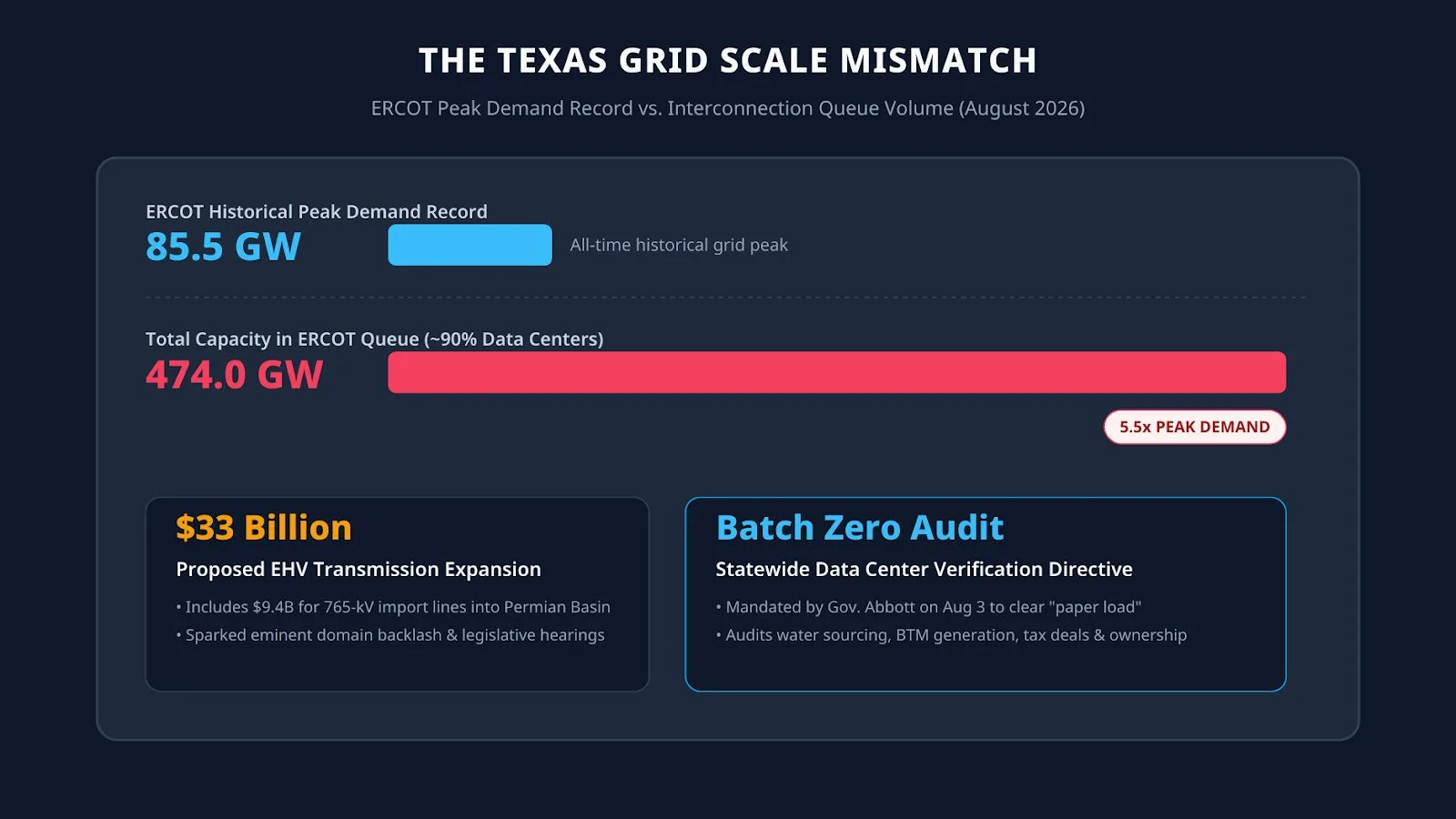
For years, the implicit rule of power grid planning was simple: load growth is good, and infrastructure follows demand. But when ERCOT’s interconnection queue surged past 474 GW of capacity requests — more than five times the grid's all-time peak demand — the legacy planning model reached its absolute limit.
The upcoming Public Utility Commission (PUC) special meeting on August 14 and the Texas House hearing on August 19 represent a collision between three unstoppable forces: hyperscale AI load growth, rural property rights, and ratepayer cost allocation.
1. The Phantom Load Problem & The Queue Trap
To understand why Texas hit the brakes, one must understand how queue speculation distorts physical infrastructure planning.
In wholesale power markets, data center developers routinely submit multiple speculative 250 MW to 1 GW interconnection requests across different substations to hedge their site selection. Under legacy rules, grid planners must treat these requests as real physical loads that will come online simultaneously.
When ERCOT aggregated these requests into “Batch Zero” — the first phase of its large-load framework under Senate Bill 6 — planners were forced to design transmission solutions for hundreds of gigawatts of theoretical demand. This led directly to ERCOT's $33 billion EHV Strategic Transmission Expansion Plan, anchored by $9.4 billion in 765-kV extra-high-voltage lines into the Permian Basin.
Designing $33 billion in ratepayer-funded physical infrastructure to serve “phantom paper load” is economically unsustainable. Abbott’s audit is a forced clearing mechanism to distinguish commercially real, capital-backed projects from speculative queue squatting.
2. The Political Economy of 765-kV Transmission
The political backlash in Texas is not coming from traditional environmental opposition; it is coming from conservative rural landowners, agricultural interests, and property rights advocates.
765-kV transmission lines require massive rights-of-way, towers over 150 feet tall, and extensive eminent domain authority. When landowners — ranging from generational cattle ranchers to public figures like Tanya Tucker — testified before the Texas Senate, they highlighted a stark geographic and economic inequality:
Rural communities are expected to host high-voltage transmission corridors under threat of eminent domain so that out-of-state hyperscalers can draw gigawatts of low-cost power.
By questioning the 765-kV buildout (Dockets 59029, 59182, 59315, 59336, and 59475), regulators and lawmakers are signaling that massive bulk-transmission overbuilds will no longer be approved without strict scrutiny over who benefits and who pays.
3. The 5-Axis Audit: What “Pay Their Own Way” Actually Means
Governor Abbott’s audit criteria shift the burden of proof entirely onto large load developers. To advance through ERCOT’s queue, data centers must now disclose five core operational vectors:
- Power & Generation Strategy: Are you bringing on-site dispatchable generation or storage, or are you demanding unconstrained baseload grid power?
- Water & Cooling Operations: Are you using air-cooled/closed-loop systems, or are you drawing millions of gallons of municipal/ground water in arid regions?
- Tax Incentives & Abatements: What local or state tax subsidies are being extracted from county budgets?
- Community & Infrastructure Impacts: How are local noise, traffic, and substation footprints being mitigated?
- Ownership Transparency: Full documentation of project controlling interests and financial counterparties.
The phrase “pay their own way” means Texas is ending the socialization of large-load interconnection costs. Going forward, hyperscalers will be required to directly fund dedicated substations, local grid upgrades, and behind-the-meter generation rather than rolling those capital expenditures into general ratepayer bills.
4. The New Reality for Data Center Developers in ERCOT
The August pause is not a temporary administrative delay; it is a preview of the 90th Texas Legislative Session convening in January 2027.
For data center operators, capital providers, and infrastructure funds, the playbook in Texas has permanently changed:
- Firm Baseload Queue Requests Are Dead: Developers asking for 500 MW of 24/7 firm power without on-site generation or flexible curtailment terms will face indefinite regulatory delays or rejection.
- Co-Location & BTM Power Win: Projects that co-locate with dedicated natural gas turbines, battery storage, or nuclear assets — and those that agree to automated curtailment during 5-minute SCED scarcity events — will jump ahead in the verification process.
- Water & Local Land Alignment: Air-cooled designs and transparent local community agreements are now mandatory prerequisites rather than optional ESG bullet points.
The era of effortless, unconstrained grid access in Texas is over. The future belongs to large loads that can prove they are net assets to grid stability rather than multi-billion-dollar liabilities for local communities.